Physiology
Postgraduate-level comprehensive notes covering cellular physiology, cardiovascular physiology, renal physiology, neurophysiology, and respiratory physiology with integrated systems approach to homeostasis.
17 chapters · MBBS / NEET-PG
Chapter 1 of 17
Cellular Physiology
Cellular Physiology
Cellular Physiology — Physiology
Cell Membrane Structure and Transport Mechanisms
Your cell membrane is a phospholipid sandwich with proteins for transport, receptors, and signaling. Stuff moves across it either passively (diffusion, facilitated diffusion) or actively (pumps that burn ATP or use the Na+ gradient). The Na+/K+ ATPase is the most important pump — and a fan-favourite exam topic.
Key exam topics:- Na+/K+ ATPase: 3 Na+ out, 2 K+ in per ATP — electrogenic, consumes 20-40% basal energy
- SGLT vs GLUT: secondary active vs facilitated diffusion — do NOT mix them up
- CFTR channel: cAMP-gated Cl- channel; deltaF508 = cystic fibrosis
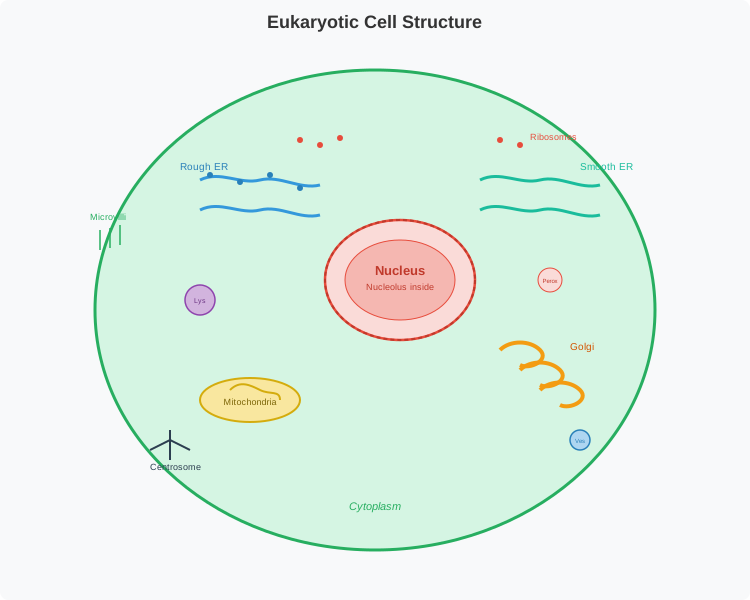
Membrane Structure
Your cell membrane is about
Membrane Proteins
About 50% of the membrane is protein. Two types:
Passive Transport
- Simple diffusion: small, lipid-soluble guys (O₂, CO₂, steroid hormones) slip right through the bilayer. Easy.
- Facilitated diffusion: needs a carrier protein (GLUT2 in liver, GLUT4 in muscle/fat — insulin-sensitive) or channel. Saturable and stereospecific.
- Aquaporins (AQP): water channels. AQP1 (RBC, kidney), AQP2 (collecting duct — ADH-regulated!), AQP4 (brain).
Active Transport
- Primary active transport: burns ATP directly. Na+/K+ ATPase (3 Na+ out, 2 K+ in per ATP — sets up the resting membrane potential, consumes 20-40% of your cell's energy!)Also Ca2+ ATPase (SERCA in SR, PMCA in plasma membrane).
- Secondary active transport: uses the Na+ gradient (which was set up by the Na+/K+ ATPase) to drag other stuff along. SGLT1 (2 Na+ per glucose, in intestine), NCX (3 Na+ in, 1 Ca2+ out — cardiac muscle), NHE (1 Na+ in, 1 H+ out — renal tubule).
- Vesicular transport: endocytosis (phagocytosis = cell eating, pinocytosis = cell drinking, receptor-mediated via clathrin-coated pits) and exocytosis (regulated or constitutive).
Membrane Potential and Action Potential Generation
Resting Membrane Potential (RMP)
- The concentration gradients of K+ (intracellular 140 mM, extracellular 4 mM — strongly driven to leave the cell), Na+ (intracellular 12 mM, extracellular 145 mM — strongly driven to enter), and Cl-
- The selective permeability of the membrane (at rest, the membrane is 50-100 times more permeable to K+ than to Na+ due to open K+ leak channels — K2P channels, specifically TWIK and TREK)
- The electrogenic Na+/K+ ATPase (contributes -4 to -10 mV directly by pumping 3 Na+ out and 2 K+ in)
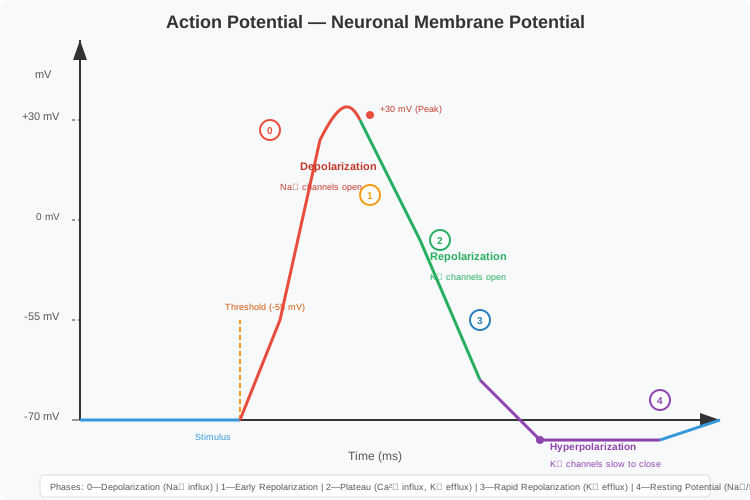
The Action Potential
- Resting state (-70 mV, all voltage-gated channels closed)
- Threshold (typically -55 mV, when the depolarization is sufficient to open voltage-gated Na+ channels — the point of no return)
- Depolarization (rapid Na+ influx through NaV channels, membrane potential swings toward ENa, reaching approximately +30 mV)
- Repolarization (NaV channels inactivate — the h-gate closes, and voltage-gated Kv channels open, K+ efflux drives the membrane back toward EK)
- Hyperpolarization/undershoot (Kv channels remain open, membrane potential transiently goes below -70 mV, approaching EK)
- Return to RMP (Kv channels close, leak channels restore the resting state)
Action Potential Propagation
Voltage-Gated Sodium Channels and Refractory Periods
Ion Channel Classification and Patch Clamp Technique
Ion channels are pore-forming membrane proteins that allow specific ions to pass down their electrochemical gradients. They are classified by gating mechanism:
- Voltage-gated channels— open/close in response to changes in membrane potential (NaV, CaV, Kv, HCN). Each has a voltage-sensing domain (S4 segment with positively charged residues).
- Ligand-gated channels— open/close in response to binding of a chemical ligand (nicotinic AChR, GABA-A, AMPA, NMDA, glycine, P2X).
- Mechanosensitive channels— respond to mechanical stretch (PIEZO1, PIEZO2 in touch and proprioception; TRPV4, TREK-1).
- Second messenger-gated channels— respond to intracellular signals (cAMP-gated CNG channels in olfactory and photoreceptor cells, IP3 receptors, ryanodine receptors).
- Passive (leak) channels— always open, responsible for resting membrane potential (K2P channels: TWIK, TREK, TASK).
Skeletal Muscle Physiology and Neuromuscular Junction
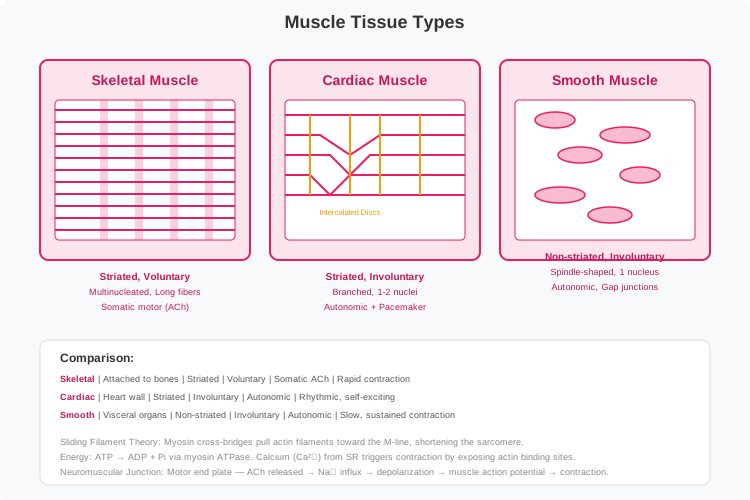
Skeletal Muscle Ultrastructure
Crossbridge Cycle
Troponin-Tropomyosin Regulation
Muscle Fibre Types and Fatigue
Summation and Tetanus
Smooth Muscle Physiology and Vascular Tone
Smooth Muscle Structure and Contraction
Calmodulin-MLCK Pathway
Endothelium-Derived Vasoactive Mediators
Myogenic Autoregulation
Cell Signaling and Signal Transduction
Cell-Cell Junctions
Major Receptor Classes
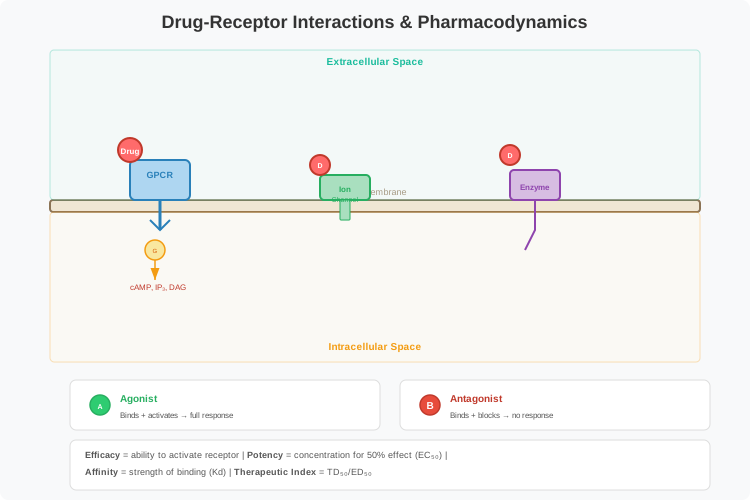
- Ion channel-coupled receptors (ionotropic receptors): ligand-gated ion channels that open upon ligand binding, mediating fast synaptic transmission (nicotinic ACh receptor — cation channel, depolarizing; GABA-A receptor — Cl- channel, hyperpolarizing/inhibitory; NMDA and AMPA glutamate receptors — cation channels, excitatory).
- G protein-coupled receptors (GPCRs, metabotropic receptors): seven transmembrane domain receptors coupled to heterotrimeric G proteins (α, β, γ subunits).Gs (stimulatory) activates adenylyl cyclase → cAMP ↑ → PKA activation. Gi (inhibitory) inhibits adenylyl cyclase → cAMP ↓. Gq activates phospholipase C → IP3 and DAG → intracellular Ca2+ release and PKC activation.
- Enzyme-coupled receptors: Receptor tyrosine kinases (RTKs) — ligand binding induces dimerization and autophosphorylation, activating Ras-MAP kinase pathway (ERK, JNK, p38), PI3K-Akt pathway, and PLCγ pathway.Examples: insulin receptor, EGF receptor, PDGF receptor, VEGF receptor. Cytokine receptors (JAK-STAT signaling). Serine/threonine kinase receptors (TGF-β superfamily) signal through Smad proteins.
| G Protein | Effector | Second Messenger | Examples |
| Gs | ↑ Adenylyl cyclase | ↑ cAMP → activate PKA, CREB | β1, β2, β3 adrenergic; D1, D5; V2 vasopressin; glucagon; TSH; ACTH; PTH; GLP-1 |
| Gi/o | ↓ Adenylyl cyclase; ↑ K+ channels | ↓ cAMP; hyperpolarization | α2 adrenergic; M2, M4 muscarinic; D2, D3, D4; μ, δ, κ opioid; 5-HT1A; GABA-B |
| Gq/11 | ↑ Phospholipase C | ↑ IP3, DAG → ↑ Ca2+, PKC | α1 adrenergic; M1, M3, M5; AT1 angiotensin; H1 histamine; 5-HT2; V1 vasopressin; OX1, OX2 orexin |
| G12/13 | ↑ RhoGEF | ↑ Rho → cytoskeletal changes | Thrombin, lysophosphatidic acid |
Second Messengers
- cAMP (synthesized by adenylyl cyclase, degraded by phosphodiesterase, activates PKA which phosphorylates many target proteins including CREB transcription factor)
- IP3 (releases Ca2+ from endoplasmic reticulum via IP3 receptors)
- DAG (activates PKC)
- Ca2+ (intracellular concentration usually 100 nM, rises to 500-1000 nM upon stimulation, binds calmodulin → CaM-Kinases, troponin C in muscle, synaptotagmin in neurotransmitter release)
Test your knowledge with practice questions
Practice Physiology MCQs →