Growth is the single most important indicator of child health. WHO growth standards, weight doublings/triplings, and the four growth phases are core NEET PG material. Know your charts — WHO (prescriptive, breastfed) vs IAP (Indian reference) vs CDC (descriptive).
Key exam topics:
Weight doubles by 5-6 months, triples by 1 year, quadruples by 2 years
WHO vs IAP vs CDC charts — prescriptive vs descriptive; breastfed infants track normally on WHO but may "drop" on CDC
FTT (organic vs non-organic) and short stature differentials (CDGP vs familial vs GHD)
Most common trap:
A single measurement below 0.4th centile does NOT equal pathology — longitudinal assessment over 6-12 months is mandatory. Velocity matters more than any single reading.
So here's the thing — growth isn't just about how big a kid gets; it's the single most reliable window into their overall health. That's why understanding it matters so much for NEET PG.
Growth is a fundamental indicator of child health and must be assessed longitudinally using standardised growth charts.
The WHO growth standards (2006) describe optimal growth for children under 5 years under favourable environmental conditions, irrespective of ethnicity.
Parameters measured include weight, length/height, head circumference (occipitofrontal circumference — OFC, measured up to 2 years), and BMI (calculated from 2 years).
Growth velocity (cm/year) is a sensitive indicator of growth disorders.
Think of growth unfolding in four distinct acts: the rapid infant growth phase (birth to 2 years — 30 cm in the first year, 12 cm in the second), steady childhood growth (2 years to puberty — 5-6 cm/year), the pubertal growth spurt (peak height velocity of 8-10 cm/year in girls at Tanner stage 3, 9-11 cm/year in boys at Tanner stage 4), and post-pubertal epiphyseal fusion.
Normal Growth Parameters at Key Ages (NEET PG High-Yield Table)
Age
Weight (approx)
Length/Height (approx)
Head Circumference (OFC)
Key Milestone
Birth (term)
3.0-3.5 kg
50 cm (+/- 2 cm)
35 cm (+/- 1.5 cm)
Moro, rooting, palmar grasp present
5-6 months
Doubles birth weight (~7 kg)
65 cm
43 cm
Sits with support, rolls over
1 year
Triples birth weight (~10 kg)
75 cm (+25 cm in 1st yr)
47 cm
Walks with support, pincer grasp
2 years
Quadruples birth weight (~12-13 kg)
87 cm (+12 cm in 2nd yr)
49 cm
Runs, 2-word phrases
3 years
~14 kg
95 cm (+8 cm/yr)
50 cm
Tricycle, copies circle
5 years
~18 kg
110 cm
51 cm
Skips, copies triangle
10 years
~30 kg
138 cm
53 cm
Pre-pubertal plateau
Memorise for NEET PG: Weight doubles by 5-6 months, triples by 1 year, quadruples by 2 years. Length increases by 50% in the first year (50 cm to 75 cm).
Comparison: WHO vs IAP vs CDC Growth Charts
Chart
Population
Feeding Mode
Age Range
NEET PG Relevance
WHO (2006)
Multi-ethnic, 6 countries (Brazil, Ghana, India, Norway, Oman, USA)
Exclusively/predominantly breastfed
0-5 years
Standard of care in India (adopted by IAP); shows how children SHOULD grow
WHO (2007)
Synthesised from WHO + NCHS data
Mixed
5-19 years
School-age children
IAP (2015)
Indian children (affluent, urban)
Mixed (breast + formula)
0-18 years
India-specific reference; slightly lower than WHO for Indian ethnicity
CDC (2000)
US children
Mostly formula-fed
0-20 years
Historical; formula-fed reference; taller/heavier than WHO
The WHO chart shows how children SHOULD grow (prescriptive, breastfed standard). CDC and IAP charts are descriptive (how children DO grow). A breastfed infant may appear to "drop" centiles on CDC charts but tracks normally on WHO charts — this is NOT failure to thrive.
Failure to Thrive (FTT)
A clinical sign of undernutrition, defined as weight persistently below the 0.4th centile, crossing down two or more centile spaces, or weight-for-height below the 2nd centile.
The aetiologies are organic (25-40% — congenital heart disease, malabsorption — coeliac disease, cystic fibrosis, gastro-oesophageal reflux, chronic kidney disease, HIV, endocrine disorders) and non-organic/psychosocial (60-75% — inadequate caloric intake due to feeding difficulties, neglect, food insecurity, or maternal depression). The investigation of FTT includes detailed dietary history, stool analysis, coeliac serology (tTG-IgA), sweat chloride test, and assessment of maternal-child interaction. Management involves multidisciplinary input with a paediatric dietitian, feeding therapy, and social work support.
FTT high-yield one-liners for NEET PG:
- Weight crossing down 2+ major centile spaces = FTT, irrespective of absolute weight centile
- Organic causes (25-40%): CHD is the single most common organic cause, followed by coeliac disease, CF, CKD, GORD
- Non-organic causes (60-75%): inadequate intake, neglect, maternal depression, food insecurity, improper formula mixing (too dilute)
- First-line investigations: 3-day dietary diary, tTG-IgA (coeliac), sweat chloride test (CF), FBC, U&E, LFT, TFT, CRP/ESR
- Catch-up growth requires 150% of expected caloric requirements for age; plot weekly weights
- Red flag combination: FTT + recurrent chest infections = CF until proven otherwise
- FTT + vomiting + diarrhoea = coeliac disease or food protein-induced enterocolitis syndrome (FPIES)
- Head sparing (normal OFC with low weight/height) suggests nutritional FTT; OFC also dropping suggests severe/prolonged malnutrition or genetic syndrome
Short Stature
Height persistently below the 2nd centile (or below -2 SDS) for age and sex.
Assessment includes parental heights (mid-parental height calculation, allowing determination of target centile range), bone age (left wrist X-ray — Greulich and Pyle atlas vs. Tanner-Whitehouse method, compared to chronological age), and screening for underlying pathology. Pathological causes include growth hormone deficiency (incidence 1/4,000, IGF-1 low, GH stimulation tests with clonidine or glucagon), Turner syndrome (45,X — consider in ANY short girl, buccal smear or lymphocyte karyotype), hypothyroidism, coeliac disease, chronic disease (renal, inflammatory bowel disease), and skeletal dysplasias.
Constitutional delay of growth and puberty (CDGP) is the most common cause of short stature in boys — normal growth velocity but delayed bone age, with a family history of late puberty.
Familial short stature is characterised by normal growth velocity, normal bone age (consistent with chronological age), and short parents.
Short Stature Differential — "GIFTED CHILD HPS":
Growth hormone deficiency / GH insensitivity (Laron)
Idiopathic (familial) / IUGR (SGA without catch-up)
Familial short stature
Turner syndrome (45,X — suspect in every short girl)
Emotional deprivation (psychosocial dwarfism — reversible when removed from adverse environment)
Down syndrome / Dysmorphic syndromes (Noonan, Prader-Willi, Silver-Russell)
Coeliac disease / Chronic disease (CRF, IBD, CHD, JIA)
Hypothyroidism
IGF-1 deficiency (GH insensitivity — Laron syndrome)
Laron dwarfism (high GH, low IGF-1)
Delayed puberty (CDGP)
Hypopituitarism (multiple pituitary hormone deficiencies)
Pituitary tumours (craniopharyngioma — most common suprasellar tumour)
Skeletal dysplasias (achondroplasia — disproportionate short stature, rhizomelic shortening)
CDGP vs Familial Short Stature vs GHD — "BONE AGE IS THE KEY":
CDGP: Bone Age = Height Age < Chronological Age (BA delayed, GV normal, FHx of late puberty)
Familial SS: Bone Age = Chronological Age (BA normal, GV normal, short parents)
GHD: Bone Age < Chronological Age (BA delayed, GV LOW, short child with normal/tall parents)
If bone age is delayed → next question: is growth velocity normal or low?
- Normal GV + delayed BA → CDGP (reassure, monitor)
- Low GV + delayed BA → GHD or hypothyroidism (investigate with IGF-1, TFT, GH stimulation test)
Growth chart pitfalls for NEET PG:
1. A SINGLE measurement below the 0.4th centile does NOT equal pathology — longitudinal assessment over 6-12 months is mandatory
2. A child tracking along the 2nd centile with normal growth velocity is constitutionally small — not pathological
3. A child crossing from the 50th to the 25th centile over 12 months HAS a growth problem even if still in the normal range — velocity is more sensitive than single centile reading
4. Bone age X-ray: always assess with Greulich & Pyle atlas (left hand and wrist PA view)
5. In CDGP, bone age = height age < chronological age — all three plotted on same timeline
6. Mid-parental height formula (Tanner): Boys = (father + mother + 13)/2 ± 8.5 cm; Girls = (father + mother - 13)/2 ± 8.5 cm
7. Pathological short stature: height below -3 SDS, growth velocity <4 cm/year, or any height below -2.5 SDS with declining centile
8. Turner syndrome (45,X): consider karyotype in EVERY short girl regardless of dysmorphism — 30% have no obvious physical features
PYQ (NEET PG / AIIMS): A 9-year-old boy has height below 3rd centile. Bone age is 7 years. Mid-parental height target is 172 cm (50th centile). Growth velocity is 6 cm/year (normal). Tanner stage 1. Father had delayed puberty (shaving at 18). What is the most likely diagnosis? Answer: Constitutional delay of growth and puberty (CDGP) — normal growth velocity, bone age delayed (consistent with height age), family history of late puberty, prepubertal. Reassure, monitor 6-monthly. Short course of low-dose testosterone (50 mg IM monthly for 3-6 months) may be offered at 14+ years for psychosocial benefit. NO growth hormone needed.
PYQ (NEET PG): A 6-year-old girl presents with short stature. She has webbed neck, low posterior hairline, widely spaced nipples, cubitus valgus. Karyotype shows 45,X. Which investigations are mandatory before starting growth hormone therapy? Answer: (1) Echocardiogram — 30% have bicuspid aortic valve or coarctation; (2) Renal ultrasound — 30-40% have renal anomalies (horseshoe kidney, duplex collecting system); (3) Thyroid function (autoimmune hypothyroidism in 30%); (4) Coeliac screen; (5) Hearing assessment (conductive and SNHL common). Start GH as early as possible (4-6 years) to maximise adult height. Oestrogen replacement around 12-14 years for pubertal induction.
Bone age assessment for NEET PG: Left hand and wrist PA view. Greulich and Pyle atlas (most common) compares the patient's radiograph to standard plates. Alternatively, Tanner-Whitehouse (TW2/TW3) method scores individual bones. Bone age is delayed (>2 SD below CA) in CDGP, GHD, hypothyroidism, chronic disease, malnutrition, and constitutional delay. Bone age is normal in familial short stature. Bone age is advanced in precocious puberty, CAH, obesity, and hyperthyroidism. Always compare bone age to chronological age and height age. In CDGP: BA = HA < CA. In GHD: BA < HA < CA.
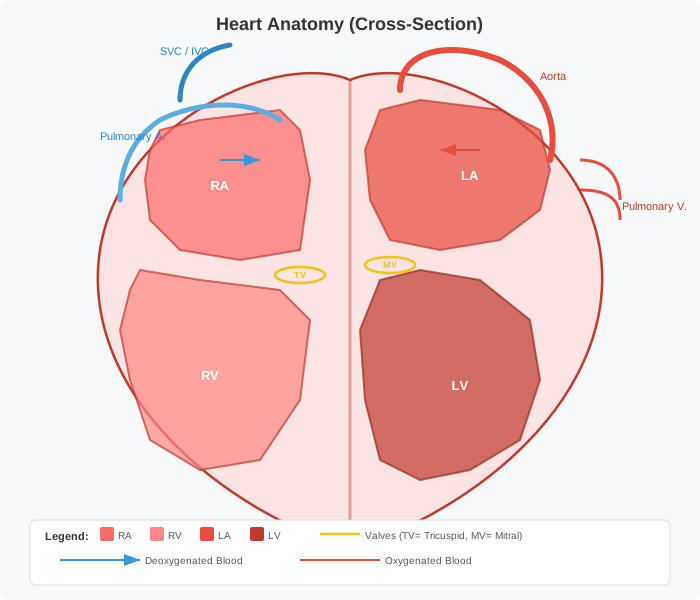
Relationship between cardiovascular development and somatic growth patterns from fetal life through adolescence.
Developmental Milestones and Assessment
Child development follows a predictable cephalocaudal and proximodistal sequence, progressing from primitive reflexes to voluntary, coordinated movements.
Developmental surveillance should be performed at every health contact using standardised tools. The four domains of development are gross motor, fine motor and vision, speech and hearing, and social behaviour.
Primitive Reflexes — Must-Know for NEET PG
Reflex
Appears (GA)
Disappears
Method of Elicitation
Significance if Persistent or Absent
Moro (startle)
28 weeks
3-4 months
Sudden head extension (drop baby 2-3 cm into examiner's hand); response: arm abduction+extension then adduction+flexion ("embrace")
The Moro reflex is the most important — asymmetric Moro suggests brachial plexus injury (Erb's palsy) or clavicle fracture; persistence beyond 6 months suggests UMN lesion/CP.
Gross Motor Milestones — Ages and Red Flags
Lifts head prone (0-3 months): 1 month briefly, 3 months sustained 45-90°, weight on forearms
Rolls prone to supine — 4 months; supine to prone — 5-6 months
Sits unsupported — 6 months (tripod sitting at 5 months)
Crawls (commando) — 7-8 months; crawls on hands and knees — 9-10 months
Complex sentences, tells stories, asks "why?" constantly — 4 years
Fluent speech, understands prepositions, can define simple words — 5 years
The critical period for language acquisition is birth to 5 years. Warning signs: no vocalisation by 6 months, no babble by 9 months, no first word by 18 months, no two-word phrases by 2.5 years, and LOSS of any language skill at ANY age (regression = always pathological).
PYQ (NEET PG / MRCPCH): A 2-year-old girl presents with no meaningful words. She has normal hearing, normal gross motor milestones, and responds to social cues. She uses gestures to communicate needs. What is the most likely diagnosis? Answer: Specific language impairment (developmental language disorder) — isolated language delay out of proportion to other domains. Red flags for autism (impaired social interaction, lack of pointing, repetitive behaviours) are absent. Management: speech and language therapy referral, audiology assessment (even if newborn screen was normal — late-onset hearing loss), and close developmental follow-up.
Social and Adaptive Behaviour Milestones
Social smile (responsive) — 6 weeks (must be differentiated from endogenous smile of sleep)
Recognises mother — 3-4 months
Stranger anxiety — 8 months (peaks at 10-18 months; must differentiate from social engagement)
Peek-a-boo / pat-a-cake — 8-10 months
Waves "bye-bye" — 10-12 months
Points to indicate wants (protoimperative pointing) — 12 months
Points to show/share interest (protodeclarative pointing) — 14-16 months
Symbolic play (pretend play — feeds doll, talks on toy phone) — 18-24 months
Parallel play (plays alongside, not with, other children) — 2-3 years
Cooperative play, shares toys, takes turns — 3-4 years
Understands rules, has "best friend" — 4-5 years
Team games, understands winning/losing — school age (5+ years)
The absence of protodeclarative pointing (pointing to show/share, not just to request) by 18 months is a RED FLAG for autism spectrum disorder (ASD).
Autism Spectrum Disorder (ASD) — Red Flags and Screening
The M-CHAT-R/F (Modified Checklist for Autism in Toddlers, Revised with Follow-up) is the standard screening tool at 18 and 24 months.
Red flags by age:
6 months: no big smiles or joyful expressions
9 months: no back-and-forth sharing of sounds, smiles, facial expressions
12 months: no babbling, no response to name, no back-and-forth gestures (pointing, showing, reaching, waving)
16 months: no spoken words
18 months: no protodeclarative pointing, no pretend play
24 months: no meaningful two-word phrases (not including imitating or repeating)
ANY age: loss of language, babbling, or social skills (regression)
Three core domains of ASD (DSM-5): (1) Persistent deficits in social communication and interaction; (2) Restricted, repetitive patterns of behaviour, interests, or activities; (3) Symptoms present in early developmental period. Level 1 (requiring support), Level 2 (requiring substantial support), Level 3 (requiring very substantial support).
ASD screening traps: (1) Many children with ASD have NORMAL gross motor milestones — don't exclude ASD based on normal walking. (2) Normal hearing test does NOT exclude ASD — hearing loss and ASD can coexist. (3) Some children with ASD have advanced splinter skills (hyperlexia — early reading without comprehension; exceptional memory for numbers). (4) Regression (loss of previously acquired language or social skills) occurs in 20-30% of ASD cases, typically at 15-24 months. (5) Screen at 18 AND 24 months — some children pass at 18 months then regress.
Developmental Delay and Global Developmental Delay (GDD)
A significant lag (delay of >2 SD below mean in one domain) or delay in two or more domains (GDD).
GDD has a broad differential diagnosis including genetic disorders (Down syndrome — most common chromosomal cause; Fragile X — most common inherited cause of intellectual disability; Rett syndrome — regression in girls aged 6-18 months, MECP2 mutation), perinatal asphyxia (HIE), intrauterine infections (CMV, rubella, toxoplasmosis), metabolic disorders (mucopolysaccharidoses, aminoacidopathies, mitochondrial disorders), and environmental deprivation.
Investigation of GDD (IAP/ AAP Guidelines)
Tier 1: Chromosomal microarray (CMA) — first-line genetic test; pick up copy number variants (replaces karyotype). Fragile X DNA testing (CGG repeat expansion in FMR1 gene).
Tier 2: Brain MRI (especially if microcephaly, macrocephaly, focal neurological signs, seizures, or regression).
Tier 4: Targeted genetic testing — whole exome/genome sequencing if CMA and Fragile X are negative. Rett syndrome (MECP2) in girls with regression. PTEN if macrocephaly + autism.
Always: TFT (congenital hypothyroidism is the most common PREVENTABLE cause of intellectual disability), hearing test (BAER/ABR), ophthalmology assessment.
Developmental Milestones — NEET PG "Age = Milestone" rapid recall:
- 6 weeks: Social smile, fixes and follows, lifts head prone (chin off bed)
- 3 months: Head steady when held sitting, laughs aloud, hands open (no more fisting)
- 6 months: Sits unsupported, transfers hand-to-hand, babbles "ba-ba", stranger anxiety begins
- 9 months: Stands holding furniture, inferior pincer grasp, says "mama/dada" specifically
- 12 months: Cruises/walks with one hand held, neat pincer grasp, 1-2 words with meaning, waves bye-bye
- 15 months: Walks alone (some), scribbles, 3-5 words, drinks from cup
- 18 months: Walks well, tower of 3 cubes, 10-15 words, feeds self with spoon, points to body parts
- 2 years: Runs, tower of 6 cubes, 2-word phrases, 50+ words, parallel play, uses spoon well
- 3 years: Tricycle, copies circle, 3-word sentences, knows full name and gender, toilet trained (day)
- 4 years: Hops on one foot, copies cross, tells stories, plays cooperatively, dresses with minimal help
- 5 years: Skips, copies triangle, draws person with 6 parts, follows 3-step commands, dresses independently
- Regression (loss of milestones) at ANY age = ALWAYS pathological — investigate urgently (metabolic, neurodegenerative, Rett syndrome, Landau-Kleffner)
- Domain dissociation: isolated gross motor delay → cerebral palsy, Duchenne muscular dystrophy; isolated speech delay → hearing loss, specific language impairment, psychosocial deprivation; isolated social delay → ASD
- Handedness before 12 months is ABNORMAL — suggests weakness/hemiplegia on non-preferred side (early hand preference = hemiparesis)
- Persistent fisting beyond 3 months is ABNORMAL — suggests UMN lesion/CP
Milestones by "Rule of 4s and 5s":
4 WEEKS: Lifts head briefly prone, fixes on face
4 MONTHS: Rolls prone to supine, reaches out, laughs aloud, head steady
8 MONTHS: Sits unsupported, stranger anxiety, transfers hand-to-hand, babbles
12 MONTHS (1 year): Walks with support, pincer grasp, 1-2 words meaningfully, waves bye-bye
18 MONTHS: Walks alone, tower of 3 cubes, 10-15 words, uses spoon, points to 3 body parts
2 YEARS: Runs, 2-word phrases, tower of 6, points to 6 body parts, parallel play
3 YEARS: Tricycle, 3-word sentences, copies circle, knows full name
4 YEARS: Hops on 1 foot, copies cross, tells stories, plays cooperatively
5 YEARS: Skips, copies triangle, draws person with 6 parts, dresses alone
"4 months: 4 achievements (roll, reach, laugh, head steady)"
"1 year: firsts (walk, words, wave, pincer)"
CNS development sequence — "Cephalocaudal + Proximodistal":
Head control → Trunk control → Sitting → Standing → Walking (cephalocaudal — head to toe)
Shoulder → Elbow → Wrist → Fingers (proximodistal — midline to periphery)
Motor development follows myelination: corticospinal tract myelination is complete by 2 years (hence Babinski is normal until 2 years, extensor plantar response after 2 years = UMN lesion)
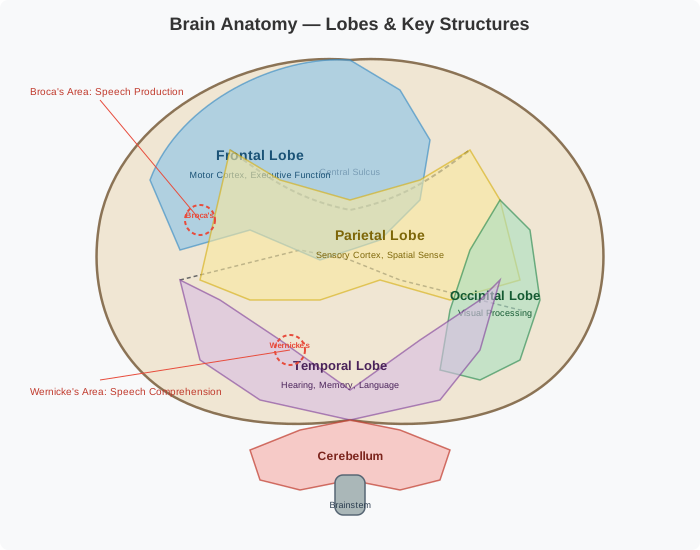
Neuroanatomical development of the brain corresponding to key developmental milestone acquisition.
Common vaccine-preventable infectious diseases and the immunological basis of herd immunity.
Adolescent Development and Pubertal Disorders
Puberty is the process of physical maturation culminating in reproductive capacity.
The hypothalamic-pituitary-gonadal axis is activated by kisspeptin (KISS1-GPR54) signalling, which triggers pulsatile GnRH secretion. The mean age of onset is 10.5-11 years in girls and 11-12 years in boys, with wide variation influenced by genetics, nutrition, body composition (leptin is permissive), and ethnicity.
Tanner Staging (Sexual Maturity Rating — SMR) for NEET PG
The standard for assessing pubertal development — must memorise all 5 stages for both sexes.
Tanner Stage
Girls: Breast (B)
Girls: Pubic Hair (PH)
Boys: Genitalia (G)
Boys: Pubic Hair (PH)
Mean Age
1
Prepubertal; elevation of papilla only
No pubic hair
Prepubertal; testes <4 mL (or <2.5 cm longest axis)
None
—
2
Breast bud (thelarche); areola widens; small mound of breast tissue
Further enlargement of breast and areola (no separation of contours)
Darker, coarser, curly; spreads over mons
Penis lengthens; testes further enlarge (8-10 mL)
Darker, coarser, curly; spreads laterally
G: 13y, B: 13-14y
4
Areola and papilla form secondary mound above breast contour
Adult type but smaller area; no spread to thighs
Penis widens; glans develops; scrotum darkens
Adult type but smaller area
G: 14y, B: 14-15y
5
Mature breast; areola recessed to general contour; papilla projects
Adult distribution; spreads to medial thighs
Adult genitalia; testes ≥15 mL
Adult distribution; spreads to medial thighs
G: 15-16y, B: 16-17y
Tanner staging — "The Rule of 2s":
Breast bud (B2) at ~10.5 years → 2 years later menarche (at B4, ~12.5 years) → 2 years later full maturity (B5, ~14.5 years)
Boys: Testicular volume 4 mL (G2 at ~12 years) → 2 years later peak height velocity (G3-4) → 2 years later spermarche (~14.5 years)
"Girls: B2 → B4 (menarche) → B5 = 2-year intervals"
"Boys: G2 (4 mL) → PHV (G3-4) → G5 = 2-year intervals"
Pubertal sequence — "Normal vs Pathological Sequence":
NORMAL GIRLS: Thelarche (B2) → Pubarche (PH2) → Growth spurt (peak at B3) → Menarche (B4, ~2 years after thelarche)
NORMAL BOYS: Testicular enlargement (G2, ≥4 mL) → Pubarche (PH2) → Penile growth (G3) → Peak height velocity (G3-4) → Spermarche
PATHOLOGICAL SEQUENCES to remember for NEET PG:
- Menarche WITHOUT thelarche = consider exogenous oestrogen, oestrogen-secreting tumour, McCune-Albright (peripheral precocious puberty)
- Pubarche WITHOUT thelarche (girls) or testicular enlargement (boys) = premature adrenarche, CAH, adrenal tumour (check DHEAS, 17-OHP)
- Thelarche at normal age but no menarche by 15 = primary amenorrhoea workup (Turner, Mullerian agenesis, androgen insensitivity)
- Testicular enlargement <4 mL in pubertal-age boy = hypogonadism (hypogonadotropic or hypergonadotropic)
Menarche typically occurs 2-2.5 years after thelarche, at Tanner B4, with a mean age of 12.5 years (range 10-15). Bone age at menarche is ~13 years.
In boys: testicular enlargement (>4 mL volume, or 2.5 cm longest axis — assessed with Prader orchidometer) is the first sign of gonadarche (mean age 12), followed by penile growth and pubic hair development. Peak height velocity occurs at Tanner stage 3-4. Spermarche (first ejaculation) occurs at a bone age of approximately 13.5-14.5 years.
Precocious Puberty
Onset of secondary sexual characteristics before age 8 in girls and 9 in boys (USA criteria; in India, some centres use <8y girls, <9y boys).
Central (GnRH-Dependent / True) Precocious Puberty
LH-predominant response to GnRH stimulation test (LH >5-8 IU/L, LH:FSH ratio >0.6).
Causes: idiopathic (90% in girls, often familial), CNS lesions (hypothalamic hamartoma — most common CNS cause; tumours — optic glioma, astrocytoma; hydrocephalus; post-meningitis/encephalitis), NF1 with optic pathway glioma, post-cranial irradiation.
Congenital adrenal hyperplasia (CAH): 21-hydroxylase deficiency — most common cause of peripheral precocious puberty in BOYS (isosexual — heterosexual in girls with virilisation). Elevated 17-OH progesterone. Treatment: glucocorticoids (hydrocortisone 10-15 mg/m2/day).
HCG-secreting tumours: hepatoblastoma, germ cell tumours, teratoma — HCG cross-reacts with LH receptor → testosterone production in boys. Boys present with precocious puberty; girls need oestrogen, so HCG usually doesn't cause precocious puberty in girls.
Ovarian tumours: granulosa cell tumour (most common oestrogen-secreting ovarian tumour in children), thecoma.
Leydig cell tumour: unilateral testicular enlargement with precocious puberty in boys.
Hypergonadotropic hypogonadism (High LH/FSH = "gonads aren't working"):
Girls: Turner (45,X) — most common; short, webbed neck, widely spaced nipples, streak gonads, cardiac/renal anomalies
Boys: Klinefelter (47,XXY) — most common; tall, gynaecomastia, small firm testes, learning difficulties, low testosterone
Both: Chemo/radiation — alkylating agents (cyclophosphamide), pelvic radiation
"Turner for girls (45,X), Klinefelter for boys (47,XXY) — high gonadotropins, primary gonadal failure"
Delayed puberty management one-liners:
- In boys >14 years: testosterone enanthate/cypionate 50-100 mg IM monthly for 3-6 months (low-dose "priming") — induces puberty, distinguishes CDGP from permanent hypogonadism (if CDGP, endogenous puberty will progress after stopping)
- In girls: conjugated oestrogen 0.15-0.3 mg or ethinyloestradiol 2-5 mcg daily (low-dose) for 3-6 months; if permanent, increase gradually over 2-3 years, then add cyclic progesterone for menstrual cycles
- In Turner syndrome: start GH at 4-6 years for height; start low-dose oestrogen at 12-14 years for pubertal induction; monitor echo (aortic root), BP, TFT, coeliac annually
- In Klinefelter: testosterone replacement from 11-12 years; fertility counselling (sperm banking may be possible via microTESE in adolescence)
- In Kallmann syndrome: pulsatile GnRH pump (if fertility desired) or hCG + FSH (for spermatogenesis) — lifelong hormone replacement otherwise
- Bone age X-ray guides therapy: if bone age ≥12 years (girls) or ≥13 years (boys), sex steroids will induce growth spurt and puberty simultaneously
- NEVER give growth hormone without checking TFT (hypothyroidism is easily treated GH-mimicker)
PYQ (NEET PG / AIIMS): A 14-year-old girl presents with short stature, webbed neck, widely spaced nipples, cubitus valgus, and absent breast development (Tanner B1). FSH is 85 IU/L. Karyotype shows 45,X. What is the most appropriate management for pubertal induction? Answer: Turner syndrome (45,X) with hypergonadotropic hypogonadism. Start GH early (4-6 years) already underway. For puberty: initiate low-dose ethinyloestradiol (2-5 mcg/day) at age 12-14 years; gradually increase over 2-3 years to adult replacement dose; then add cyclic progesterone (medroxyprogesterone 10 mg × 10 days/month) for endometrial protection. Before oestrogen: mandatory echocardiogram (BAV, coarctation — 30%), renal US (horseshoe kidney, duplex — 40%), TFT, coeliac screen. Fertility: egg donation may be an option (streak gonads — no spontaneous puberty).
Neuroendocrine pathways of the hypothalamic-pituitary-gonadal axis in the initiation of puberty.