The eye develops from four embryonic sources, and knowing which structure comes from which layer is a classic exam question. The choroidal fissure must close by week 7 — failure gives you a coloboma.
Corneal endothelium and trabecular meshwork come from neural crest cells, not surface ectoderm.
Embryonic Origins
Think of the eye as a four-source project: the neural ectoderm gives you the retina and optic nerve, the surface ectoderm handles the lens and corneal epithelium, mesenchyme builds the sclera and extraocular muscles, and neural crest cells are the overachievers that form the trabecular meshwork, corneal endothelium, iris stroma, and ciliary muscle.
Timeline
The optic vesicle appears around day 22 from the forebrain. It invaginates to form the optic cup by day 27. The lens placode forms from surface ectoderm and invaginates to form the lens vesicle by day 33. The hyaloid vascular system nourishes the developing lens and regresses by the 8th month.
Key developmental events: The choroidal fissure closes by week 7. The iridopupillary membrane atrophies by the 7th month. The fovea centralis differentiates postnatally, completing development by age 4.
The anterior chamber angle develops through a complex process of mesenchymal differentiation and cleavage, with the trabecular meshwork and Schlemm's canal becoming functional by birth.
Congenital Anomalies
Congenital anomalies include coloboma (failure of choroidal fissure closure — "keyhole" pupil and inferior iris defect), persistent hyperplastic primary vitreous (PHPV — retrolental fibrovascular membrane from failure of hyaloid system regression), Peters anomaly (corneal endothelial defect with central corneal opacity, iridocorneal adhesions), aniridia (PAX6 gene mutation — bilateral iris hypoplasia, foveal hypoplasia, nystagmus, glaucoma risk), and congenital cataract (rubella — "pearl" cataract, metabolic disorders — galactosemia "oil droplet" cataract, hereditary autosomal dominant). Congenital glaucoma (buphthalmos) presents with photophobia, epiphora, corneal edema, Haab's striae (breaks in Descemet's membrane), and optic disc cupping.
Q: What is the embryonic origin of the trabecular meshwork and corneal endothelium? A: Neural crest cells.
Q: Failure of closure of the choroidal fissure results in which congenital anomaly? A: Coloboma — presents as a "keyhole" pupil with inferior iris defect.
Optic Nerve and Orbital Apex
The optic nerve develops from the optic stalk. Retinal ganglion cell axons grow through the stalk toward the brain. The lamina cribrosa develops from neural crest cells. The orbital apex contains the optic nerve, ophthalmic artery, and cranial nerves III, IV, V1, VI through the annulus of Zinn.
Lens Zonules
The lens zonules (zonules of Zinn) are microfibrils composed primarily of fibrillin-1 that suspend the lens from the ciliary body. They insert onto the lens capsule 1-2 mm anterior and posterior to the equator. With age, zonular fragility increases — clinically relevant in pseudoexfoliation syndrome, high myopia, trauma, and Marfan syndrome.
Figure 1A: Ocular embryogenesis — optic cup formation and lens placode invagination.
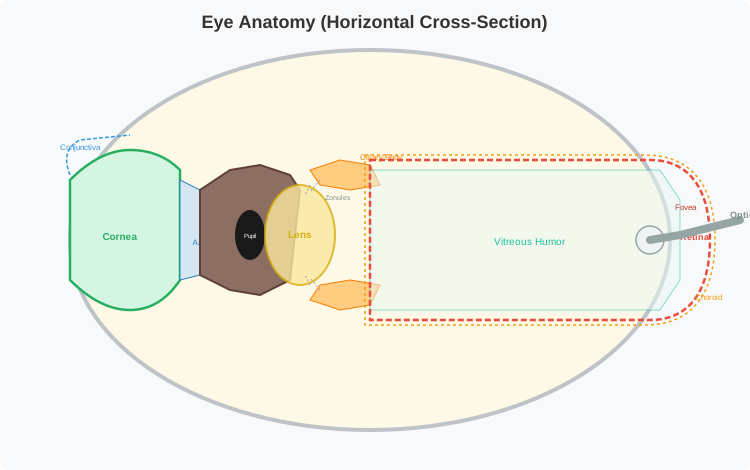
The adult eyeball measures approximately 24 mm in anteroposterior diameter, 23 mm in vertical diameter, and weighs about 7.5 g.
It consists of three concentric coats: the outer fibrous coat (cornea and sclera), the middle vascular coat (iris, ciliary body, choroid), and the inner nervous coat (retina).
Cornea
The cornea is 11-12 mm horizontally and 10-11 mm vertically, with a central thickness of 520 μm and peripheral thickness of 650 μm.
Corneal layers from external to internal: Epithelium, Bowman's, Stroma, Descemet's, Endothelium — "Every Bad Student Does Exams" or "Eat Breakfast Slowly, Don't Eat"
It has five layers: epithelium (5-6 layers of stratified squamous cells, regenerates completely in 7 days), Bowman's membrane (acellular collagen layer, does not regenerate after injury), stroma (90% of corneal thickness, highly ordered collagen lamellae responsible for transparency), Descemet's membrane (basement membrane of endothelium, regenerates), and endothelium (single layer of hexagonal cells, density decreases with age, responsible for corneal deturgescence via Na+/K+ ATPase pump).
Sclera
The sclera is 1 mm thick posteriorly and 0.3 mm at the rectus muscle insertions. The lamina cribrosa is a sieve-like area where the optic nerve exits.
Anterior Chamber
The anterior chamber depth is 3.5-4.0 mm centrally. The angle of the anterior chamber contains the trabecular meshwork (uveal, corneoscleral, and juxtacanalicular layers), Schlemm's canal (collector channels leading to aqueous veins), scleral spur, and ciliary body band.
Lens
The lens is a biconvex, avascular structure measuring 9-10 mm in diameter and 4-5 mm in thickness.
It has a capsule (thickest anteriorly), subcapsular epithelium (only anteriorly), cortex, and nucleus. The crystalline lens proteins (crystallins) account for 35% of lens weight. Accommodation is achieved through contraction of the ciliary muscle, releasing zonular tension and allowing the lens to become more spherical.
Orbital Apex and Annulus of Zinn
The annulus of Zinn is a tendinous ring at the orbital apex giving origin to the four rectus muscles. The optic nerve (CN II), ophthalmic artery, CN III divisions, nasociliary nerve, and CN VI pass through it. CN IV, lacrimal and frontal nerves pass outside. Apical lesions cause combined CN III, IV, V1, and VI palsies (superior orbital fissure syndrome).
Figure 2: Horizontal cross-section of the human eye illustrating major anatomical structures.
Figure 3: Orbital apex — cranial nerves through superior orbital fissure and optic canal.
Figure 5: Ciliary ganglion — final common pathway for pupillary constriction and accommodation.
Ocular Circulation and Innervation
Arterial Supply
The ophthalmic artery is the first branch of the internal carotid artery.
Its branches include the central retinal artery, short posterior ciliary arteries, long posterior ciliary arteries, anterior ciliary arteries, lacrimal artery, muscular arteries, and supraorbital artery.
The central retinal artery supplies the inner retina (ganglion cells to inner nuclear layer). The choroidal circulation (via posterior ciliary arteries) supplies the outer retina (photoreceptors) and is under sympathetic control. The anterior segment receives blood from the anterior ciliary arteries and long posterior ciliary arteries.
Venous Drainage
Venous drainage: The central retinal vein and vortex veins (4-7 in number) drain into the superior and inferior ophthalmic veins, then into the cavernous sinus.
Innervation
Sensory Innervation
Sensory innervation of the eye comes from the ophthalmic division of the trigeminal nerve (V1). Its branches include the lacrimal nerve, frontal nerve (supratrochlear and supraorbital), and nasociliary nerve (long ciliary nerves, infratrochlear nerve, ethmoidal branches).
Motor Innervation
Motor innervation: CN III (oculomotor) supplies the superior rectus, medial rectus, inferior rectus, inferior oblique, levator palpebrae superioris, and carries parasympathetic fibers to the sphincter pupillae and ciliary muscle. CN IV (trochlear) supplies the superior oblique. CN VI (abducens) supplies the lateral rectus. CN VII (facial) supplies the orbicularis oculi. Sympathetic fibers from the superior cervical ganglion innervate the dilator pupillae, Müller's muscle, and orbital smooth muscle.
Ciliary Ganglion
The ciliary ganglion lies between the optic nerve and lateral rectus. Its three roots are: sensory (nasociliary nerve), parasympathetic (oculomotor nerve) —
these are the important motor fibers for pupillary constriction and accommodation
, and sympathetic (internal carotid plexus).
Extraocular Muscles and Ocular Motility
Actions of Extraocular Muscles
The six extraocular muscles and their primary actions are: medial rectus (adduction), lateral rectus (abduction), superior rectus (elevation, intorsion, adduction), inferior rectus (depression, extorsion, adduction), superior oblique (intorsion, depression, abduction), and inferior oblique (extorsion, elevation, abduction).
Muscle Spiral of Tillaux
The muscle spiral of Tillaux describes the spiral arrangement of the rectus muscle insertions: medial rectus at 5.5 mm from limbus, inferior rectus at 6.5 mm, lateral rectus at 6.9 mm, and superior rectus at 7.7 mm.
Laws of Ocular Motility
The actions of the extraocular muscles are governed by the laws of ocular motility: Listing's law (each muscle has a specific plane of action), Sherrington's law (reciprocal innervation — increased innervation to an agonist is accompanied by decreased innervation to its antagonist), and Hering's law (equal and simultaneous innervation flows to synergistic muscles for conjugate eye movements).
The three axes of Fick: X-axis (horizontal) for vertical movements, Y-axis (vertical) for horizontal movements, Z-axis (anteroposterior) for torsional movements.
Blood Supply and Innervation
The blood supply comes from the muscular branches of the ophthalmic artery and the lacrimal artery. The lateral rectus receives blood from the lacrimal artery. The inferior rectus and inferior oblique receive blood from the infraorbital artery.
Innervation: Oculomotor nerve (CN III) supplies medial rectus, superior rectus, inferior rectus, and inferior oblique. Trochlear nerve (CN IV) supplies superior oblique. Abducens nerve (CN VI) supplies lateral rectus.
Clinical EOM Anatomy
Each rectus inserts via tendon to sclera along the spiral of Tillaux. The superior oblique tendon passes through the trochlear pulley. The inferior oblique originates from maxillary bone and runs posteriorly. The vortex veins lie beneath rectus insertions and are vulnerable during muscle surgery.
Figure 10: Extraocular muscles — rectus muscles and obliques with primary and secondary actions.
Figure 11: Brainstem nuclei — CN III (oculomotor), CN IV (trochlear), CN VI (abducens).
Figure 12: Medial longitudinal fasciculus — connecting CN III and CN VI for horizontal gaze.