Medical jurisprudence is how medicine meets the law. Every doctor needs to know consent rules, confidentiality exceptions, and the legal duties that come with the license.
Key exam topics:
Types of consent & when each applies
NMC Act 2019 & Telemedicine Guidelines 2020
Professional misconduct & disciplinary action
Most common trap:
Students confuse implied consent (e.g., rolling up a sleeve for injection) with informed consent for surgery. They are NOT the same thing.
Hey there — let's start with the basics.
Medical jurisprudence is the application of medical knowledge to the administration of justice.
It covers the legal duties of doctors, patient rights, and the medicolegal side of everyday practice.
The Indian Medical Council (Professional Conduct, Etiquette and Ethics) Regulations, 2002, govern professional conduct for registered doctors in India.
The Medical Council of India (MCI) — now the National Medical Commission (NMC) — can remove a doctor's name from the medical register for professional misconduct.
Think of the doctor-patient relationship as a fiduciary one — built on trust. You have a duty of care, a duty to keep things confidential, and a duty to get informed consent. On the flip side, the patient has the right to know, the right to choose, and the right to say no.
Consent is the voluntary agreement of a patient to undergo a medical examination, investigation, or treatment.
Types of consent: Implied consent (non-verbal, assumed by the patient's actions — e.g., rolling up a sleeve for an injection). Expressed consent (verbal or written).
Informed consent: the patient must be given the nature, purpose, and risks of the procedure, any alternatives, and the consequences of refusal.
The consent must be free from coercion, undue influence, fraud, misrepresentation, or mistake.
Capacity to consent: An adult (>18 years) with a sound mind can give valid consent. In emergencies, consent is implied. A minor (<18 years) requires parental or guardian consent. A mentally ill patient is not competent to consent — a guardian or a magistrate's order is required.
Consent in Specific Situations
Criminal abortion — no one can give consent (it is illegal)
Therapeutic abortion (Medical Termination of Pregnancy Act, 1971) — up to 20 weeks (now extended to 24 weeks under the MTP Amendment Act 2021) — requires the opinion of one registered medical practitioner (for up to 12 weeks) or two registered medical practitioners (for 12-24 weeks). Beyond 20 weeks, a medical board's approval is needed
Sterilization — requires a valid consent
HIV testing — requires specific informed consent and pre- and post-test counseling
Organ transplantation (The Transplantation of Human Organs Act, 1994) — requires specific consent, and donation from a living donor is only allowed for a near relative (or, with approval from the authorization committee, for a non-near relative)
Confidentiality: All information about a patient is confidential. Exceptions: when required by law (Notification of infectious diseases — under the Epidemic Diseases Act, 1897, and now the Epidemic Diseases Act, 2020 — COVID-19 was a notifiable disease; reporting of births and deaths). Court order (disclosure in a court of law, in response to a subpoena or a court order). Public interest (a serious risk to the public — e.g., the patient has a serious infectious disease that poses a risk to the community, or the patient is an airline pilot with epilepsy). The patient's duty to protect a third party (Tarasoff duty in the US — not legally established in India, but ethically sound).
Professional misconduct (infamous conduct): Examples: advertising (soliciting patients), professional secrecy (breach of confidentiality), fee-splitting (kickbacks), and running a pharmacy or a nursing home (if it creates a conflict of interest).
"Infamous conduct" is defined by the General Medical Council (GMC) in the UK as "serious professional misconduct" and by the MCI as "professional misconduct."
Disciplinary action: the medical council can warn, suspend, or remove the doctor's name from the medical register. "A registered medical practitioner who is found guilty of professional misconduct may be suspended from practice for a specified period or may have his name removed from the register."
Medical Ethics: Core Principles
Medical ethics is the application of ethical principles to the practice of medicine.
Four pillars: (1) Autonomy - the patient has the right to self-determination and informed consent. (2) Beneficence - the doctor must act in the best interest of the patient. (3) Non-maleficence - "first, do no harm" (primum non nocere). (4) Justice - fair distribution of healthcare resources and non-discrimination.
In India, the Code of Medical Ethics (MCI/NMC Regulations) codifies these principles into enforceable standards. Breach of ethics can lead to removal from the medical register.
The NMC Act 2019
The NMC Act replaced the Medical Council of India (MCI) with the National Medical Commission (NMC).
The NMC has four autonomous boards: Under-Graduate Medical Education Board (UGMEB), Post-Graduate Medical Education Board (PGMEB), Medical Assessment and Rating Board (MARB), and Ethics and Medical Registration Board (EMRB). Key changes: common final year MBBS examination (National Exit Test NEXT) will serve as the postgraduate entrance exam and the license to practice. The NMC retains disciplinary powers through the EMRB.
The State Medical Councils continue to handle disciplinary matters at the state level, with appeals to the NMC.
The National Medical Register (NMR) now includes all licensed practitioners with unique registration numbers.
Telemedicine Practice Guidelines 2020
Telemedicine is the delivery of healthcare services using information and communication technologies.
The Board of Governors (in supersession of MCI) issued the Telemedicine Practice Guidelines in 2020. Key provisions: registered medical practitioners can provide telemedicine consultations.
Informed consent must be obtained (implied or explicit). The doctor must follow the same standard of care as in-person consultations. Prescriptions must include the doctor's registration number and the mode of consultation. Controlled substances cannot be prescribed via telemedicine (Schedule X drugs, narcotics, psychotropics).
Documentation and record-keeping follow the same legal requirements. Video consultations are preferred for first encounters; telephone consultations are permissible for follow-ups or when video is not available.
Important IPC Sections for Medical Practice
Key IPC sections: Section 52 (good faith), Section 80 (accident in lawful act), Section 81 (act likely to cause harm without criminal intent), Section 87-92 (consent limits), Section 176 (omission to give notice), Section 191-193 (false evidence), Section 201 (disappearance of evidence), Section 269-271 (negligent spread of infection), Section 304A (death by negligence), Section 312 (causing miscarriage), Section 320 (grievous hurt), Section 376 (rape), Section 377 (unnatural offences).
MTP Amendment Act 2021
The Medical Termination of Pregnancy Amendment Act 2021 extended the upper gestational limit from 20 to 24 weeks for certain categories.
Key changes: termination up to 20 weeks requires one doctor; 20-24 weeks requires two doctors; beyond 24 weeks requires medical board approval.
The Act expanded the definition of rape and failure of contraception for unmarried women. Confidentiality of the woman's identity is protected.
Capacity to consent requires intact cognitive function — cortical and brainstem integrity for decision-making.
The medicolegal process: examination, evidence collection, documentation, and court testimony.
Medical Certificates and Medicolegal Reports
Medical certificates are official documents issued by a registered medical practitioner that attest to a medical fact.
The most important certificates in forensic practice are:
Death Certificate
The cause of death is stated. The format is prescribed by the World Health Organization (WHO) and is used globally: Part I — the immediate cause of death (the disease or condition directly leading to death — e.g., cardiorespiratory arrest), Part II — the underlying cause of death (the disease or injury that initiated the train of events — e.g., acute myocardial infarction), and Part III — other significant conditions that contributed to the death but are not related to the disease or condition causing it.
The death certificate is a medicolegal document. The doctor must be certain of the cause of death; if a patient dies within 24 hours of admission to the hospital or if the death is due to an unnatural cause, the death should be reported to the police.
Common errors in death certification: listing the mechanism (cardiorespiratory arrest) instead of the underlying cause; listing "old age" as the cause; failing to report unnatural deaths to the police.
Birth Certificate
A certificate issued by a registered medical practitioner attesting to the live birth of a child, with date, time, place, sex, and parent names.
The birth certificate establishes identity, age, and nationality. Birth must be registered within 21 days. A "stillbirth" (child born dead after 28 weeks) is registered separately.
Injury Certificate
A description of the injuries, the nature of the weapon (by appearance of the wound: blunt, sharp, fire-arm), the age of the injury (from the histological and clinical features of healing), and a statement of the relationship of the injury to the alleged assault.
Sickness Certificate
A certificate that the patient is suffering from a specific disease (and is unfit for work — the "medical certificate of fitness for work" or the "fit note").
Dying Declaration
A statement made by a person who believes that death is imminent.
It is a written statement recorded by a magistrate, a doctor, or a police officer.
The declarant must be of sound mind and the statement must be voluntary. It is admissible in court as evidence, even if the person dies (a "dying declaration" is a hearsay exception).
The dying declaration can be oral or written. If the person survives, it can be used as a statement under Section 164 CrPC. The magistrate must certify that the declarant was of sound mind. The doctor must certify that the patient is conscious and capable of making a statement.
Multiple dying declarations: the court evaluates the consistency of each.
Medicolegal Autopsy Report
A detailed written record of the findings of a medicolegal autopsy. The format: Identity of the deceased (name, age, sex, address, ID marks), details of the police investigation (who ordered the autopsy, the date, time, and place of the autopsy), external examination (height, weight, build, rigor mortis, injuries, scars, and other marks), internal examination (each body cavity: the skull, the brain, the chest, and the abdomen; the viscera are removed and described; and the toxicology samples are collected). The opinions section (the cause of death, the time since death, and the mechanism of injury).
The report is a legal document — any error or omission could affect the course of justice.
Duties of a Medical Witness in Court
A registered medical practitioner can be called as a witness (to give evidence as an expert witness or as a fact witness). The medical witness should be neutral and objective. The witness should give only the facts and express an opinion only within the field of expertise. The doctor should be prepared to be cross-examined by the defense and the prosecution and should maintain a calm, professional demeanor. The doctor should produce the original medical records. The doctor should speak clearly and slowly, and should address the judge (not the lawyer asking the question). The doctor should ask for clarification if the question is not understood. If the doctor is an expert witness, the opinion is given on the balance of probabilities (civil case) or beyond a reasonable doubt (criminal case).
Structure of a Medicolegal Report
A medicolegal report is a formal written document prepared by a medical practitioner at the request of a law enforcement agency or court.
Essential components: (1) Identity of the examining doctor (name, qualification, registration number, designation). (2) Authority requesting the examination (police station, magistrate, FIR number). (3) Identity of the person examined (name, age, sex, address, identifying marks). (4) Date, time, and place of examination. (5) History as given by the patient or the police. (6) General physical examination findings. (7) Detailed injury description (type, number, size, location, shape, direction, age). (8) Opinion: nature of injury (simple/grievous), weapon used, duration of injury, endangerment to life. (9) Specimens collected and their disposition. (10) Signature and seal of the examining doctor.
Key principle: The report must be complete, objective, and legible. Any omission can be exploited during cross-examination. The doctor should not express an opinion beyond their expertise.
Pecuniary and Professional Liability
A doctor who issues a false or fraudulent medical certificate or medicolegal report is liable for professional misconduct and legal action.
Issuing a false certificate: Section 192 IPC (fabricating false evidence), Section 193 IPC (punishment for false evidence). The medical council may also remove the doctor from the register.
Never issue a certificate or report without personally examining the patient or the body. Backdating or ante-dating certificates is a serious professional misconduct.
Histological features for wound age estimation: polymorphs (6-12 hrs), macrophages (24-48 hrs), fibroblasts (3-5 days).
Medical Negligence and Consumer Protection
Negligence is the breach of a duty of care that results in damage.
In medical practice, a doctor is negligent if he or she does not exercise the "ordinary skill and care" of a reasonably competent medical practitioner in the same field. "A doctor is not negligent if he is acting in accordance with a practice accepted as proper by a responsible body of medical men skilled in that particular art." (Bolam test, England 1957). The Bolitho modification (1997) — the body of medical opinion must be "logical" and "capable of withstanding logical analysis."
The three elements of negligence (the "three Ds"):
Duty of care (a doctor-patient relationship exists)
Dereliction of duty (the doctor has breached the standard of care)
Damage (the patient has suffered harm as a direct result of the breach — the "proximate cause")
Res ipsa loquitur ("the thing speaks for itself"): The harm is so obvious that negligence is presumed.
The burden shifts to the doctor to disprove negligence. Three conditions: The accident is of a type that does not normally occur without negligence. The injury was caused by an instrumentality within the exclusive control of the defendant. The plaintiff did not contribute to the injury.
Examples: leaving a swab or a surgical instrument in the abdomen after surgery ("a surgical swab left in the abdomen is res ipsa loquitur — a classic case of negligence"). Wrong-site surgery (operating on the wrong limb or the wrong eye). Anesthesia accidents.
Contributory negligence: The patient's own actions contributed to the injury (e.g., the patient fails to return for follow-up, or the patient fails to take prescribed medication). In India, the concept of "contributory negligence" is used to reduce the damages awarded, not to bar the claim.
Vicarious liability: The employer is responsible for the negligence of an employee (the "master-servant" rule).
A hospital is vicariously liable for the negligence of its nursing staff, and a senior surgeon may be vicariously liable for the negligence of an assistant (if the assistant is an employee of the doctor). Independent contractors: if the doctor is an independent contractor (e.g., a visiting consultant), the hospital is not vicariously liable — but this area of law is complex and the trend is to hold the hospital liable for any negligence in its premises.
The Consumer Protection Act (CPA), 1986 (and now the Consumer Protection Act, 2019): Medical services are covered under the CPA.
A patient can file a complaint in the Consumer Disputes Redressal Forum (at the district, state, or national level) for a "deficiency in service" (negligence) or "unfair trade practice" (e.g., charging for a service that was not provided, false advertising). The patient does not need to prove negligence (the CPA standard is "deficiency in service" — a wider and less stringent standard than the tort law). The limitation for filing a complaint is 2 years from the date of the deficiency. The patient can claim compensation, refund of fees, and cost of litigation.
The CPA has been a major tool for patients to sue doctors for negligence.
Criminal negligence: A doctor can be prosecuted for "gross negligence" (negligence of such a high degree that it amounts to a criminal act).
The Supreme Court of India (Dr. Suresh Gupta vs. Govt. of NCT of Delhi, 2004) — "a doctor must be shown to have acted with a high degree of recklessness, a total disregard for the life and safety of the patient, before a conviction for criminal negligence can be sustained." The Jacob Mathew case (2005) — the Supreme Court laid down that "a doctor cannot be held criminally negligent unless it is shown that the doctor exhibited gross negligence or a reckless disregard for the life and safety of the patient." The court differentiated "civil negligence" (compensable by damages) from "criminal negligence" (punishable by imprisonment).
Important Medical Negligence Cases
Jacob Mathew vs. State of Punjab (2005)
: gross negligence standard for criminal liability
Dr. Suresh Gupta vs. NCT of Delhi (2004)
: simple error of judgment is not criminal negligence
Samira Kohli vs. Dr. Prabha Manchanda (2008)
: consent must be specific to the procedure
Kusum Sharma vs. Batra Hospital (2010)
: unsuccessful treatment is not necessarily negligence
P. B. Desai vs. State of Maharashtra (2013)
: Bolam test is the standard for civil negligence
Q: Which landmark Supreme Court case established that a doctor cannot be held criminally negligent unless gross negligence or reckless disregard for patient safety is demonstrated? A: Jacob Mathew vs. State of Punjab (2005). The court differentiated civil negligence (compensable by damages) from criminal negligence (punishable by imprisonment). A simple error of judgment is not criminal negligence — Dr. Suresh Gupta vs. NCT of Delhi (2004). Samira Kohli vs. Dr. Prabha Manchanda (2008) established that consent must be specific to the procedure performed.
Wound healing stages used in dating injuries and assessing standard of care in negligence cases.
Identification – Medicolegal Aspects
Identification of the living and the dead is a crucial aspect of forensic medicine. It involves establishing the unique identity of an individual.
Methods of Identification
Race, sex, age, stature, complexion, hair color, eye color, scars, moles, tattoos, occupational marks, dental records, fingerprints, palm prints, footprints (controversial), DNA profiling, anthropometry (Bertillon system — measurements of the body, the head, and the ear — now obsolete as the primary method, replaced by fingerprinting and DNA), and personal effects (jewelry, clothing, documents, and other belongings). The corpus delicti ("the body of the crime") — the identity of the victim must be established before the crime can be investigated.
Organ Transplantation: Legal Framework
The Transplantation of Human Organs and Tissues Act (THOTA), 1994 (amended 2011 and 2014) governs organ donation and transplantation in India.
Key provisions: brainstem death is legally recognized as death (Section 2(d)). Living donors can donate only to near relatives (spouse, siblings, parents, children). Non-near-relative donations require authorization committee approval. Commercial organ trading is illegal (punishment: up to 5 years imprisonment and fine).
THOTA defines brain death certification: a board of four doctors (registered medical practitioner in charge of the hospital, surgeon/physician, neurologist/neurosurgeon, and the treating doctor) must jointly certify brain death.
Deceased donation (cadaveric) requires consent from the next of kin. The National Organ and Tissue Transplant Organization (NOTTO) coordinates organ allocation.
A doctor involved in organ transplantation must never participate in organ trading. Violation leads to criminal prosecution and removal from the medical register.
`,
Age Estimation
In the living: physical examination (height, weight, dentition, ossification of bones on X-ray), radiology (X-ray of the wrist, elbow, knee, pelvis — the standard Greulich and Pyle atlas for the hand and wrist; the Tanner-Whitehouse method for hand bone age; and the radiographic assessment of the medial clavicular epiphysis —
the fusion of the medial clavicular epiphysis occurs between 20 and 25 years — a very useful determination for the upper-limit age of ossification for forensic purposes
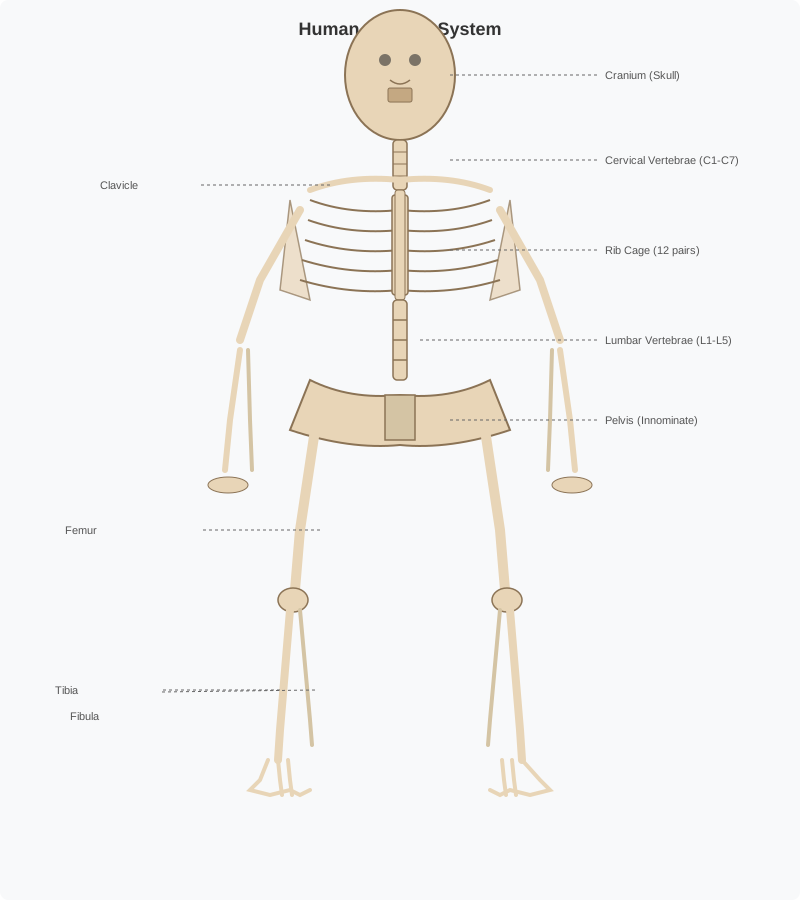
). Dental development (the eruption of primary and permanent teeth and the stages of tooth development — a chart of the timing of tooth eruption and root formation is used — the Demirjian classification of tooth mineralization). In the dead: the same methods are used, but a full post-mortem examination of the skeleton and the bones is possible. The pelvis (the morphology of the pubic symphysis, the shape of the subpubic angle, and the greater sciatic notch) is used for sex determination. The skull: the shape of the brow, the face, the mastoid process, the mandible, and the bone density. The sternum: the fusion of the sternal segments (the "manubriosternal joint" and "xiphisternal joint" fuse at various ages).
Determination of Sex
The most accurate method is DNA profiling (80,000 X and Y chromosome markers — the amelogenin gene on the X chromosome and on the Y chromosome).
The pelvic bone gives the most reliable morphological sex determination (the female pelvis is wider, the subpubic angle is >90°, the sciatic notch is wide, and the pubic bone is wider — the Phenice criteria for the pubis). The skull is the second most reliable method (the male skull is larger and heavier, with more prominent muscle insertions, the brow ridge is more prominent, the mastoid process is larger, and the mandible is heavier with a wider, more square chin). The femur (the length, the neck shaft angle, and the carrying angle of the arm) also contribute.
Stature Estimation
The most accurate method is the "anatomical method" (the addition of all the bones in the skeleton — the "Fully method" — the sum of the heights of the skull, the spine, the femur, the tibia, and the talus and the calcaneum). The "regression formula method" (the Pearson formulae, the Trotter and Gleser regression equations based on the femur, tibia, humerus, and radius) —
"stature is estimated from the length of long bones — the femur is the most reliable single bone for the estimation of stature."
The formula differs for the sex and the race.
DNA Profiling (DNA Fingerprinting)
A technique that analyzes the non-coding regions of the human genome (the tandem repeats — the short tandem repeats — STRs — at multiple genetic loci).
The technique uses a set of primers that amplify the specific STR loci. The current standard is the Combined DNA Index System (CODIS) — 20 STR loci are analyzed. The probability of a match (the probability that two individuals will have the same STR profile) is extremely small (typically 1 in a quadrillion or more). A "DNA profile" is obtained from any biological sample (blood, semen, saliva, hair, bone).
It is the gold standard for identification (disaster victim identification — DVI, and missing person investigations).
The technology is highly sensitive — it can be used on degraded DNA samples (from a mass disaster, an old bone, a small drop of blood). The technique is governed by the DNA Technology (Use and Application) Regulation Bill in India, which is currently pending.
Fingerprints
The ridge patterns (arches, loops, whorls) are unique to each individual.
They are used for identification of the living (by the police) and the dead (post-mortem fingerprints are taken at the autopsy).
The pattern is formed by the sixth month of intrauterine life and does not change (except by scarring). Fingerprints are used for individualization — the identification of an individual from a crime scene (a "latent fingerprint" or a "patent fingerprint"). The classification system: the Henry system (the primary, secondary, sub-secondary, tertiary, and final classes). The Automated Fingerprint Identification System (AFIS) allows for rapid computer-based matching.
Forensic Odontology
Forensic odontology is the application of dental science to legal investigations, primarily for identification of human remains and bite mark analysis.
Teeth are the hardest structures in the human body, surviving decomposition, fire, and trauma. Dental identification compares antemortem and postmortem records.
Bite mark analysis, lip prints (cheiloscopy), and palatal rugae patterns are also used for identification.
Age estimation: eruption sequence, Gustafson method, and Demirjian classification.
Q: Which epiphysis is most useful for determining whether a person has attained 18 years of age? A: The fusion of the medial clavicular epiphysis (medial end of clavicle) occurs between 20-25 years — it is useful for the upper-limit age determination. For the 18-year threshold, the fusion of the distal radius epiphysis (around 18-20 years), iliac crest epiphysis (17-19 years), and the appearance of the pisiform bone (9-12 years) are examined. The most reliable method combines X-ray of the wrist, elbow, and pelvis with dental development assessment.