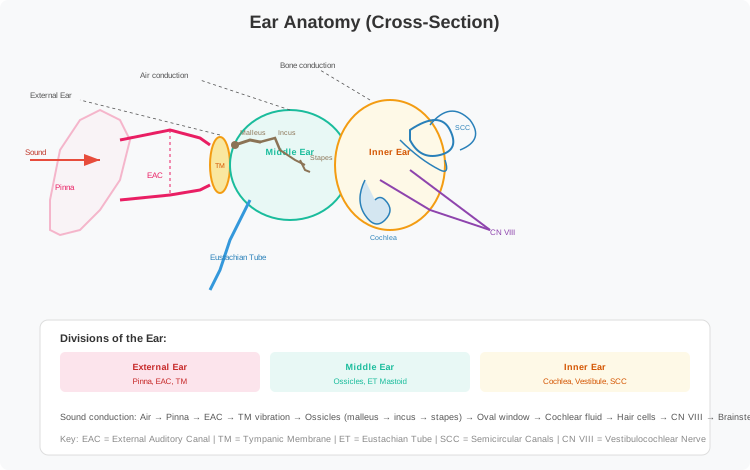
The temporal bone (5 parts) houses the external, middle, and inner ear. Key structures include the ossicles (malleus, incus, stapes), Eustachian tube, cochlea with organ of Corti, and semicircular canals for balance.
Key exam topics:
Sclerotic mastoids are associated with chronic otitis media
Stapedius reflex contracts at >70-80 dB SPL
Basilar membrane tonotopy — base responds to high frequencies, apex to low frequencies
Most common trap:
The bony EAC has skin only 0.2 mm thick with no subcutaneous tissue — instrumenting roughly here causes severe pain and bleeding.
Let's start with the basics — the temporal bone is made of five parts: squamous, petrous, mastoid, tympanic, and styloid process. The petrous part is the one that houses your inner ear. The mastoid process comes with air cells that can be cellular, diploetic, or sclerotic — and here's the high-yield pearl:
sclerotic mastoids are associated with chronic otitis media
.
External Ear
The external ear consists of the auricle (pinna) and the external auditory canal (EAC). The auricle has a complex cartilaginous framework covered by thin skin. Blood supply: posterior auricular and superficial temporal arteries. Lymphatic drainage: pre-auricular, post-auricular, and upper deep cervical nodes. The EAC measures 24 mm in length (outer cartilaginous 8 mm, inner bony 16 mm). The isthmus is the narrowest point at the bony-cartilaginous junction. The skin of the cartilaginous EAC contains hair follicles, sebaceous glands, and ceruminous glands (modified apocrine sweat glands).
The bony EAC has thin skin (0.2 mm) adherent to the periosteum with no subcutaneous tissue, making it very sensitive.
Middle Ear (Tympanic Cavity)
An air-filled space within the petrous temporal bone. It is bounded by: laterally — the tympanic membrane; medially — the promontory (covering the basal turn of the cochlea), oval window (fenestra vestibuli), and round window (fenestra cochleae); superiorly — the tegmen tympani (separates the middle ear from the middle cranial fossa); inferiorly — the jugular bulb; posteriorly — the mastoid antrum and the facial nerve; anteriorly — the Eustachian tube orifice and the carotid artery. The ossicles: malleus (hammer), incus (anvil), and stapes (stirrup). The two middle ear muscles: tensor tympani (innervated by CN V) and stapedius (innervated by CN VII).
The stapedius reflex is the contraction of the stapedius muscle in response to loud sound (>70-80 dB SPL).
Eustachian Tube
Connects the middle ear to the nasopharynx. It is 36 mm long, directed downward, forward, and medially at a 45° angle. The outer third is bony, the inner two-thirds are cartilaginous (normally closed, opened by contraction of the tensor veli palatini during swallowing, yawning, or sneezing). The Eustachian tube has three functions: ventilation of the middle ear (equalization of air pressure), protection from nasopharyngeal secretions, and clearance (drainage) of middle ear secretions.
Inner Ear (Labyrinth)
Consists of the bony labyrinth (perilymph-filled) and the membranous labyrinth (endolymph-filled). The bony labyrinth comprises the vestibule (containing the saccule and utricle), the three semicircular canals (superior, posterior, and lateral at right angles to each other), and the cochlea. The membranous labyrinth contains the sensory organs: the organ of Corti in the cochlea for hearing, the maculae of the utricle and saccule for static balance (linear acceleration), and the cristae of the semicircular canals for dynamic balance (angular acceleration).
The cochlea is a spiral structure with 2.75 turns. The basilar membrane is narrow and stiff at the base (responding to high frequencies) and wide and floppy at the apex (responding to low frequencies). This tonotopic organization is the basis of frequency discrimination.
Figure 1: Cross-sectional anatomy of the ear illustrating the external ear canal, tympanic membrane, ossicles, cochlea, and vestibular apparatus.
Anatomy of the Nose and Paranasal Sinuses
The external nose is a pyramidal structure with a bony upper third (nasal bones, frontal process of maxilla) and a cartilaginous lower two-thirds (upper and lower lateral cartilages, septal cartilage).
Nasal Cavity
Extends from the nares (nostrils) anteriorly to the choanae posteriorly (communicating with the nasopharynx). The lateral wall contains the three turbinates (conchae): inferior (a separate bone — the largest), middle (part of the ethmoid), and superior (part of the ethmoid).
The middle meatus is the most important — it contains the osteomeatal complex (OMC), which is the common drainage pathway for the frontal sinus, anterior ethmoidal cells, and maxillary sinus.
The uncinate process, ethmoidal bulla, hiatus semilunaris, and infundibulum are key components of the OMC.
Paranasal Sinuses
Air-filled cavities within the bones of the skull lined by pseudostratified ciliated columnar epithelium. The maxillary sinus (the largest, 15-30 mL volume) drains into the middle meatus via the ostium in the infundibulum.
The ostium is at the highest point, making the maxillary sinus susceptible to infection when the ostium is blocked.
The frontal sinus drains through the frontal recess or frontonasal duct into the hiatus semilunaris. The ethmoidal sinuses (anterior 3-15 cells draining into the middle meatus; posterior 1-6 cells draining into the superior meatus). The sphenoid sinus drains into the sphenoethmoidal recess.
Nerve Supply to the Nose
Olfactory nerve (CN I) — distributed to the olfactory mucosa of the upper third of the septum and lateral wall. Ophthalmic division (V1) — anterior ethmoidal nerve supplies the anterior part. Maxillary division (V2) — sphenopalatine nerve supplies the posterior part.
Little's area (Kiesselbach's plexus) is the anastomotic area on the anteroinferior part of the nasal septum — the most common site of epistaxis.
Anatomy of the Pharynx and Larynx
The pharynx is a fibromuscular tube, 12-14 cm long, extending from the base of the skull to the inferior border of the cricoid cartilage.
It is divided into three parts: nasopharynx (behind the nose and above the soft palate), oropharynx (behind the oral cavity, from the soft palate to the hyoid bone), and laryngopharynx (from hyoid to cricoid).
Nasopharynx
Bounded by the posterior choanae anteriorly, the soft palate inferiorly, the clivus posteriorly, and the roof (the pharyngeal tonsil — adenoid). The lateral wall contains the Eustachian tube opening (torus tubarius), the fossa of Rosenmüller (the pharyngeal recess behind the torus —
a common site for nasopharyngeal carcinoma
).
Oropharynx
Contains the palatine tonsils (between the palatoglossal and palatopharyngeal arches), the base of the tongue (lingual tonsil), the vallecula (between the base of the tongue and the epiglottis), and the lateral and posterior pharyngeal walls.
Waldeyer's ring of lymphatic tissue includes the adenoid, tubal tonsils, palatine tonsils, and lingual tonsil.
Larynx
Extends from the laryngeal inlet to the inferior border of the cricoid cartilage (C3-C6 in adults). Cartilaginous skeleton: unpaired (thyroid — the largest, with Adam's apple; cricoid — the only complete tracheal ring; epiglottis — leaf-shaped) and paired (arytenoids — pyramidal, with vocal and muscular processes; corniculate; cuneiform).
Laryngeal Cavity — Three Regions
Supraglottis: from the epiglottis to the false vocal cords
Glottis: the true vocal cords and the anterior and posterior commissures
Subglottis: from the true vocal cords to the inferior border of the cricoid
Intrinsic laryngeal muscles: posterior cricoarytenoid — the only abductor (opening the vocal cords); lateral cricoarytenoid — adductor; cricothyroid — lengthens and tenses the vocal cords; thyroarytenoid — shortens and relaxes the cords.
The recurrent laryngeal nerves (RLN) supply all intrinsic laryngeal muscles except the cricothyroid (supplied by the external branch of the superior laryngeal nerve — SLN).
The right RLN recurs around the right subclavian artery; the left RLN recurs around the aortic arch.
Muscle
Innervation
Action
Clinical significance
Posterior cricoarytenoid
RLN (CN X)
Abducts vocal cords
Only abductor — bilateral palsy causes stridor
Lateral cricoarytenoid
RLN (CN X)
Adducts vocal cords
Loss causes breathy voice
Thyroarytenoid (vocalis)
RLN (CN X)
Shortens/relaxes cords
Fine-tuning of pitch
Cricothyroid
External SLN (CN X)
Lengthens/tenses cords
Only intrinsic muscle not supplied by RLN — loss limits pitch range