Anatomy
Postgraduate-level comprehensive notes covering systemic anatomy, cardiovascular system, nervous system, musculoskeletal system, and respiratory system with detailed structural and functional correlations.
16 chapters · MBBS / NEET-PG
Chapter 1 of 16
Systemic Anatomy
Systemic Anatomy
Systemic Anatomy — Anatomy
Basic Structural Organization of the Human Body
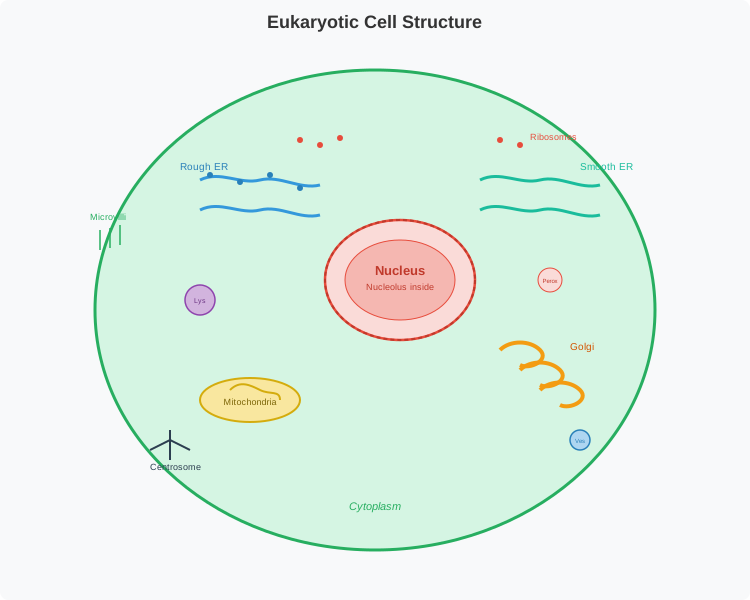
The human body is built like Russian nesting dolls: atoms → molecules → cells → tissues → organs → systems. You need to know which tissue does what, which cavity houses which organ, and how to tell your epithelia from your connective tissue.
Key exam topics:- Epithelial vs connective tissue — know the differences COLD
- Body cavities and their contents (dorsal vs ventral)
- Muscle types: skeletal vs cardiac vs smooth
Hierarchical Organization
Body Cavities and Membranes
Your body has two big real estate zones for organs:
- Dorsal cavity— the "back side" holds your brain (cranial cavity) and spinal cord (vertebral canal).
- Ventral cavity— the "front side" holds everything else: thoracic cavity (heart + lungs) above the diaphragm, abdominopelvic cavity below it.
The diaphragm is the VIP bouncer separating your chest from your belly.
- Serous membranesare double-layered cling wrap around your organs. Parietal layer = outer wrap. Visceral layer = inner wrap touching the organ. Between them? A tiny gap with serous fluid — just enough lube to prevent friction.
- Three serous membranes to know: Pleura (lungs), Pericardium (heart), Peritoneum (abdomen).
- The mesenteryis a peritoneum fold that holds your intestines against the back wall, carrying blood vessels and nerves like utility lines.
Epithelial Tissue
- Simple squamous— found in blood vessels (endothelium) and body cavities (mesothelium). Think: diffusion highway.
- Simple cuboidal— lines kidney tubules and glands. These cells are workhorses for secretion and absorption.
- Simple columnar— lines your gut. Has goblet cells (mucus makers) and microvilli (surface area boosters).
- Stratified squamous— your skin! Built for protection against abrasion.
- Pseudostratified ciliated columnar— lines your airways. Cilia sweep mucus (and trapped junk) upward. Think: respiratory escalator.
- Transitional epithelium— only in urinary tract. It stretches when your bladder fills. Like origami, but biological.
Connective Tissue
Connective tissue is the "filler" that holds everything together. Cells are scattered in an extracellular matrix (ECM) of fibers + ground substance. Unlike epithelium, cells here are spread out — they like personal space.
- Loose (areolar)— the packing peanuts beneath your skin.
- Adipose— fat cells that store energy, insulate, and cushion.
- Dense regular— tendons and ligaments. Collagen fibers all lined up like soldiers for max tensile strength.
- Dense irregular— dermis and organ capsules. Fibers go every direction to resist multidirectional forces.
- Cartilage(hyaline, elastic, fibrocartilage) — flexible support with shock-absorbing superpowers.
- Bone— osteons with concentric lamellae wrapped around central canals. Like tree rings, but structural.
- Blood— yep, it's a connective tissue. Cells floating in plasma = liquid ECM.
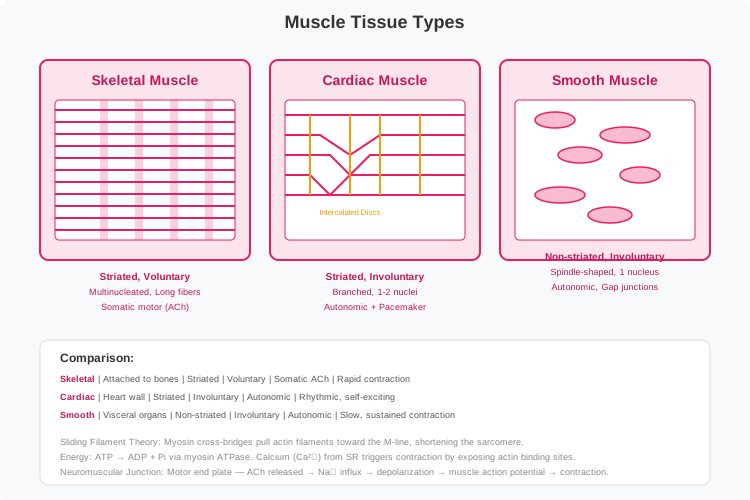
Muscle Tissue
Three types, one job: contract. Here's how to tell them apart:
- Skeletal— voluntary, striated, many nuclei on the edges. Your gym muscles.
- Cardiac— involuntary, striated, 1-2 nuclei in the center. Intercalated discs with gap junctions = synchronized heart beating.
- Smooth— involuntary, no striations, one cigar-shaped nucleus. Found in blood vessels and organs. The quiet worker.
Nervous Tissue
Two cell types:
Anatomical Planes and Directional Terms
| Plane | Description |
|---|---|
| Sagittal | Vertical cut dividing body into left and right. Midsagittal = down the middle; parasagittal = off-center. |
| Coronal (frontal) | Vertical cut dividing into front (anterior) and back (posterior). |
| Transverse (horizontal) | Horizontal cut dividing into top (superior) and bottom (inferior). |
| Oblique | Any angled cut between horizontal and vertical. |
Key directional pairs: superior (cranial)/inferior (caudal), anterior (ventral)/posterior (dorsal), medial/lateral, proximal/distal (for limbs), superficial/deep, ipsilateral/contralateral.
Epithelial vs Connective Tissue — Key Comparison
| Feature | Epithelial Tissue | Connective Tissue |
|---|---|---|
| Cells | Packed tight like sardines | Scattered; lots of ECM between them |
| Blood supply | Avascular (gets food by diffusion) | Vascular (except cartilage) |
| Basement membrane | Yes — sits on it | No — cells hang out in ECM |
| Polarity | Apical-basal (top vs bottom) | No polarity |
| Regeneration | Fast (stem cells in basal layer) | Variable (bone heals well, cartilage struggles) |
| Embryonic origin | All 3 germ layers | Primarily mesoderm |
Cardiac vs Skeletal vs Smooth Muscle — Comparison
| Feature | Skeletal | Cardiac | Smooth |
|---|---|---|---|
| Striations | Yes | Yes | No |
| Nuclei | Multiple, peripheral | 1-2, central | Single, central, cigar-shaped |
| T-tubules | A-I junction (2/sarcomere) | Z-line (1/sarcomere) | None or basic |
| Intercalated discs | No | Yes (gap junctions + desmosomes) | No (gap junctions in single-unit only) |
| Control | Voluntary (somatic) | Involuntary (autonomic + intrinsic pacemaker) | Involuntary (autonomic, hormonal) |
| Regeneration capacity | Limited (satellite cells) | Minimal (scarring) | Excellent |
| Embryonic origin | Paraxial mesoderm (somites) | Splanchnic mesoderm | Splanchnic mesoderm + neural crest (head) |
Endochondral vs Intramembranous Ossification
| Feature | Endochondral Ossification | Intramembranous Ossification |
|---|---|---|
| Cartilage model | Hyaline cartilage forms first, then replaced by bone | No cartilage; bone forms directly from mesenchymal membrane |
| Primary ossification center | Diaphysis (shaft) | Multiple centers within membrane |
| Secondary centers | Epiphyses (after birth) | None (expands from centers) |
| Growth mechanism | Epiphyseal (growth) plate — interstitial growth in length | Appositional growth from periosteum |
| Bones formed | All long bones (femur, humerus, tibia), vertebrae, ribs, pelvis, base of skull | Flat skull bones (frontal, parietal), mandible, clavicle (shaft), facial bones |
| Clinical relevance | Achondroplasia: defect in endochondral ossification (FGFR3 mutation) | Cleidocranial dysostosis: defect in intramembranous ossification (RUNX2) |
Tissue Types Summary for NEET PG
NEET PG High-Yield Rapid Revision
Critical Facts for NEET PG Mastery
NEET PG Last-Minute Revision Pearls
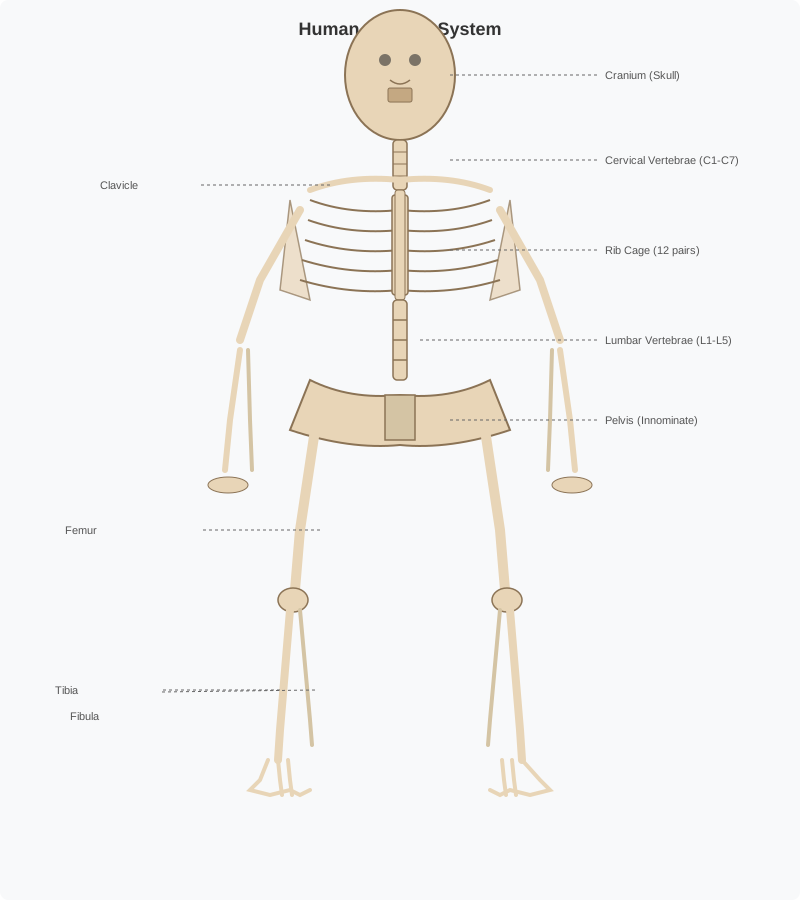
The Skeletal System: Axial and Appendicular Skeleton
Axial Skeleton (80 bones)
The axial skeleton consists of 80 bones:
- Skull — 22 bones (8 cranial, 14 facial)
- Vertebral column — 26 bones (7 cervical, 12 thoracic, 5 lumbar, 1 sacrum, 1 coccyx)
- Thoracic cage — 24 ribs and 1 sternum
- Hyoid bone
Appendicular Skeleton (126 bones)
- Pectoral girdle — clavicle and scapula
- Upper limbs — humerus, radius, ulna, 8 carpal bones, 5 metacarpals, 14 phalanges
- Pelvic girdle — two hip bones fused at the pubic symphysis
- Lower limbs — femur, patella, tibia, fibula, 7 tarsal bones, 5 metatarsals, 14 phalanges
Vertebral Anatomy
Each vertebra has a vertebral body anteriorly and a vertebral arch posteriorly, forming the vertebral foramen. The arch consists of two pedicles and two laminae, with seven processes: one spinous, two transverse, and four articular processes (superior and inferior). The intervertebral foramina, formed by adjacent vertebral notches, transmit spinal nerves.
- Atlas (C1)— lacks a body and spinous process, consisting of anterior and posterior arches with lateral masses.
- Axis (C2)— has the odontoid process (dens) projecting upward for rotation with the atlas.
- Typical cervical vertebra (C3-C6)— small body, transverse foramina for the vertebral artery, bifid spinous process.
- Vertebra prominens (C7)— long, prominent spinous process palpable at the base of the neck.
Ribs
The ribs are classified as:
- True ribs (1-7)— attaching directly to the sternum via costal cartilage.
- False ribs (8-10)— attaching indirectly via the costal cartilage of rib 7.
- Floating ribs (11-12)— no anterior attachment.
Each rib has a head (articulates with the vertebral body), neck, tubercle (articulates with the transverse process), and shaft. The costal groove along the inferior border of each rib protects the intercostal neurovascular bundle.
Intercostal muscles comprise three layers:
- External intercostals— elevate ribs during inspiration, fibers directed downward and forward.
- Internal intercostals— depress ribs during forced expiration, fibers directed downward and backward.
- Innermost intercostals— similar orientation to internal, spanning multiple intercostal spaces.
Skull
The skull comprises the
Clinically Important Skull Foramina
| Foramen | Transmits |
|---|---|
| Foramen magnum | Medulla oblongata, vertebral arteries |
| Jugular foramen | CN IX, X, XI, internal jugular vein |
| Foramen ovale | CN V3, accessory meningeal artery |
| Foramen spinosum | Middle meningeal artery |
| Optic canal | CN II, ophthalmic artery |
Axial vs Appendicular Skeleton — Comparison
| Feature | Axial Skeleton (80 bones) | Appendicular Skeleton (126 bones) |
|---|---|---|
| Location | Central axis of body (midline) | Limb girdles + free limbs |
| Components | Skull, vertebral column, ribs, sternum, hyoid | Pectoral girdle, upper limbs, pelvic girdle, lower limbs |
| Primary function | Protection of CNS, heart, lungs; posture; muscle attachment | Locomotion, manipulation, weight-bearing |
| Ossification type | Both endochondral (vertebrae, ribs, base of skull) and intramembranous (skull vault) | Primarily endochondral (long bones); clavicle = both types |
Cervical, Thoracic, and Lumbar Vertebrae — Regional Comparison
| Feature | Cervical (C3-C7) | Thoracic (T1-T12) | Lumbar (L1-L5) |
|---|---|---|---|
| Body | Small, oval; uncinate processes laterally | Medium, heart-shaped; costal facets for ribs | Large, kidney-shaped (reniform); largest bodies |
| Vertebral foramen | Large, triangular (largest relative to body size) | Small, circular | Triangular, intermediate |
| Transverse processes | Contain foramen transversarium (vertebral artery passes C1-C6; NOT C7) | Long, strong; costal facets on T1-T10 for rib articulation | Thin, long (represent fused ribs) |
| Spinous process | Short, bifid (C3-C6); C7 is long non-bifid (vertebra prominens) | Long, sloping inferiorly (imbricated like roof tiles) | Short, rectangular, horizontally directed |
| Articular facets | Oriented 45° to horizontal plane | Coronal plane orientation | Sagittal plane orientation (medial/lateral) |
Skull Foramina Complete NEET PG Reference
| Foramen | Bone | Contents |
|---|---|---|
| Foramen magnum | Occipital | Medulla oblongata, vertebral arteries, CN XI spinal root, anterior/posterior spinal arteries |
| Jugular foramen | Temporal + Occipital | CN IX, X, XI; sigmoid sinus → IJV |
| Foramen ovale | Sphenoid (greater wing) | CN V3 (mandibular); accessory meningeal artery; lesser petrosal nerve |
| Foramen spinosum | Sphenoid (greater wing) | Middle meningeal artery (anterior division); meningeal branch V3 |
| Foramen rotundum | Sphenoid (greater wing) | CN V2 (maxillary) |
| Optic canal | Sphenoid (lesser wing) | CN II; ophthalmic artery; sympathetic fibers |
| Superior orbital fissure | Sphenoid (between greater + lesser wings) | CN III, IV, V1, VI; superior ophthalmic vein |
| Hypoglossal canal | Occipital | CN XII |
| Internal acoustic meatus | Temporal (petrous) | CN VII, VIII; labyrinthine artery |
| Stylomastoid foramen | Temporal | CN VII (facial nerve exit from skull) |
NEET PG High-Yield Rapid Revision
Critical Facts for NEET PG Mastery
NEET PG Last-Minute Revision Pearls
Joints and Their Classifications
Joints (articulations) are classified structurally by the presence or absence of a joint cavity and the type of connecting tissue, and functionally by the degree of movement permitted.
Fibrous Joints (Synarthroses)
Lack a joint cavity, with bones connected by dense fibrous connective tissue.
- Sutures— found between skull bones, interlocking edges that fuse with age (synostosis).
- Syndesmoses— greater distance between bones connected by a ligament (e.g., distal tibiofibular joint).
- Gomphoses— peg-in-socket joints (periodontal ligament anchoring teeth in alveoli).
Cartilaginous Joints (Amphiarthroses)
Lack a joint cavity with bones united by cartilage.
- Synchondroses— united by hyaline cartilage (e.g., epiphyseal plates in growing bone, first sternocostal joint).
- Symphyses— united by fibrocartilage (e.g., intervertebral discs, pubic symphysis).
Synovial Joints (Diarthroses)
Have a joint cavity lined by a synovial membrane that produces synovial fluid for lubrication and nutrient distribution. Articular surfaces are covered by hyaline cartilage (except the temporomandibular and sternoclavicular joints, which have fibrocartilage). The joint capsule consists of an outer fibrous layer and inner synovial membrane. Accessory structures include articular discs (menisci in the knee, articular disc in the TMJ), fat pads, and bursae (fluid-filled sacs reducing friction between structures).
Classification by Movement Axis
| Type | Axis | Examples |
|---|---|---|
| Hinge | Uniaxial | Elbow, interphalangeal joints |
| Pivot | Uniaxial | Proximal radioulnar joint |
| Condylar | Biaxial | Knee, wrist |
| Saddle | Biaxial | Carpometacarpal joint of the thumb |
| Ball and socket | Multiaxial | Shoulder, hip |
Comprehensive Synovial Joint Types — Exam Reference
| Type | Axis | Movement | Examples |
|---|---|---|---|
| Plane (gliding) | None (sliding only) | Sliding/gliding | Intercarpal, intertarsal, acromioclavicular, zygapophyseal (facet) joints |
| Hinge (ginglymus) | Uniaxial | Flexion/Extension only | Elbow (humeroulnar), IP joints, ankle (talocrural) |
| Pivot (trochoid) | Uniaxial | Rotation only | Proximal radioulnar, atlantoaxial (median) |
| Condylar (ellipsoid) | Biaxial | Flex/Ext + Abd/Add; NO rotation | Knee (modified), radiocarpal (wrist), MCP joints |
| Saddle (sellar) | Biaxial + limited rotation | Flex/Ext + Abd/Add + opposition | 1st CMC (thumb), sternoclavicular |
| Ball & Socket (spheroid) | Multiaxial | All movements | Shoulder (glenohumeral), hip (coxal) |
Joint Stability Factors and Clinical Correlations
NEET PG High-Yield Rapid Revision
Critical Facts for NEET PG Mastery
NEET PG Last-Minute Revision Pearls
Dermatomes, Myotomes, and Peripheral Nerve Distribution
Dermatomes
A dermatome is an area of skin supplied by a single spinal nerve segment. Knowledge of dermatomal distribution is essential for localizing neurological lesions.
| Spinal Level | Key Landmark |
|---|---|
| C5 | Shoulder (deltoid region) |
| C6 | Thumb and lateral forearm |
| C7 | Middle finger |
| C8 | Little finger and medial forearm |
| T4 | Nipple line |
| T10 | Umbilicus |
| L4 | Medial knee and leg |
| L5 | Great toe and dorsum of foot |
| S1 | Lateral foot and heel |
| S2-S4 | Perineum (saddle region) |
Myotomes
A myotome is a group of muscles innervated by a single spinal nerve segment.
| Spinal Level | Muscle Group | Action Tested |
|---|---|---|
| C5 | Deltoid, biceps | Shoulder abduction, elbow flexion |
| C6 | Wrist extensors | Wrist extension |
| C7 | Elbow extensors | Elbow extension, finger extension |
| C8 | Finger flexors | Finger flexion |
| T1 | Interossei | Finger abduction |
| L2-L3 | Iliopsoas | Hip flexion |
| L4 | Quadriceps | Knee extension |
| L5 | Tibialis anterior | Ankle dorsiflexion |
| S1 | Gastrocnemius, soleus | Ankle plantarflexion |
Upper vs Lower Limb Myotomes — Quick Comparison
| Spinal Level | Upper Limb Action | Lower Limb Action |
|---|---|---|
| C5 / L2-L3 | Shoulder abduction (deltoid) | Hip flexion (iliopsoas) |
| C6 / L4 | Elbow flexion + wrist extension | Knee extension (quadriceps) |
| C7 / L5 | Elbow extension + finger extension | Ankle dorsiflexion (tibialis anterior) |
| C8 / S1 | Finger flexion | Ankle plantarflexion (gastrocnemius) |
| T1 / S2 | Finger abduction (interossei) | Toe flexion |
Clinical Myotome Examination Complete
| Level | Muscle | How to Test | Peripheral Nerve |
|---|---|---|---|
| C5 | Deltoid | Shoulder abduction against resistance | Axillary nerve |
| C6 | Biceps + wrist extensors | Elbow flexion; wrist extension against resistance | Musculocutaneous + Radial |
| C7 | Triceps | Elbow extension against resistance | Radial nerve |
| C8 | Finger flexors (FDP) | Finger flexion (grip strength) | Median + Ulnar |
| T1 | Dorsal interossei | Finger abduction against resistance | Ulnar nerve |
| L2 | Iliopsoas | Hip flexion (supine, lift leg) | Femoral nerve |
| L3 | Quadriceps | Knee extension | Femoral nerve |
| L4 | Tibialis anterior | Ankle dorsiflexion | Deep peroneal nerve |
| L5 | Extensor hallucis longus | Great toe extension | Deep peroneal nerve |
| S1 | Gastrocnemius/soleus; peronei | Ankle plantarflexion; foot eversion | Tibial nerve; Superficial peroneal |
NEET PG High-Yield Rapid Revision
Critical Facts for NEET PG Mastery
NEET PG Last-Minute Revision Pearls
Test your knowledge with practice questions
Practice Anatomy MCQs →